Introduction
Non-suicidal self-injury (NSSI) refers to the deliberate damaging of one’s body tissue, without intending to commit suicide and for reasons that are not sanctioned socially nor culturally (Baker & Lewis, 2013). It is a concerning behavior which affects a great part of the youth: the lifetime prevalence of self-injury is 13% among emerging adults, 20% among university students, and ranges from 13% to 18% among teenagers in community settings (Lewis & Hasking, 2023).
Considerable findings have been made over the past two decades, particularly regarding risk factors associated with self-injury, such as suicidal behavior (Whitlock et al., 2013), and psychological issues such as depression, anxiety or post-traumatic stress disorder (Taylor et al., 2018).
Yet, the very experience of individuals who engage in self-injury is still often overlooked. For example, the choice of self-injury methods has rarely been investigated in academic research. Several methods are used to engage in self-injury, with the most common being cutting (Franzén & Gottzén, 2011; Lewis, 2016; Sternudd, 2010). Other methods consist of burning, hitting, stabbing or excessive rubbing (American Psychiatric Association, 2013). Little is known about why an individual turns to a specific method instead of another. The current study seeks to provide possible answers to this interrogation.
Literature review
Number of methods
Research about methods of self-injury has predominantly focused on the number of methods used by an individual. Three categories of individuals with self-injury have been found: those with low frequency of self-injury, individuals who use one method of self-injury primarily (often cutting), and individuals with high frequency NSSI who use multiple methods (Tilton-Weaver et al., 2025). In a survey aimed at females who engage in self-injury, 75% of respondents reported engaging in multiple methods of harm (Favazza & Conterio, 1989). A 2025 research on adolescents suggests girls engage in more repeated self-injury, and use more methods than boys (Tilton-Weaver et al., 2025).
A greater number of methods endorsed by an individual has been found to be associated to greater risk for suicide attempts and suicide ideation (Glenn & Klonsky, 2009; Victor & Klonsky, 2014; Turner et al., 2013), depression (Ammerman et al., 2019), substance use (Ammerman et al., 2019), and some personality traits, particularly openness and less conscientiousness (Robertson et al., 2013). However, these studies analyzed numbers of methods indifferently of which methods were used. We may therefore wonder if specific methods are also meaningful.
Differences between methods
Research comparing methods of self-injury is rare, but has drawn some conclusions regarding gender. Women are more likely to cut or scratch themselves whereas men tend to punch themselves or an object, bang their head, or burn themselves (Andover et al., 2010; Sornberger et al., 2012; Whitlock et al., 2011). Yet, it is important to interpret these results with nuance, as there is not always a sharp contrast between male and female self-injury. For example cutting remains prevalent among males who engage in self-injury (Sornberger et al., 2012).
More recently, research has started investigating the association of some specific methods of self-injury with risk factors. Ammerman et al. (2019) investigated this aspect in an undergraduate population. Their findings show that self-hitting is associated with anger (Ammerman et al., 2019), and, along with cutting, with suicide attempts, hospital visits, and unintentional severe harm (Ammerman et al., 2019). Self-carving words or pictures has been found to be correlated to suicide ideation (Ammerman et al., 2019) and self-biting with earlier age of onset (Ammerman et al., 2019). In a clinical population with substance use disorder, Baer et al. (2019) found that cutting was the only method strongly associated with suicide attempts, particularly unambivalent attempts or attempts which required medical attention (Baer et al., 2019).
In 2005, Matsumoto et al. (2005) studied the difference between self-cutting and self-burning in a Japanese juvenile detention center. They found that subjects who engage in both self-cutting and self-burning were predominantly male, whereas female subjects engaged mainly in self-cutting only. Those who engaged in self-cutting, or both self-cutting and self-burning also had experienced more trauma than those who engaged in self-burning only, or in no form of self-injury. Those who engaged in both self-cutting and self-burning were more at risk for depression and dissociation (Matsumoto et al., 2005). However, these results can only be interpreted in light of the Japanese context. When screening for a history of self-burning, Matsumoto et al. asked subjects whether they had ever burned themselves with a lit cigarette deliberately. This practice, called Konjo-yaki, is frequent in Japanese correctional settings and among at-risk youth to prove their courage (Matsumoto et al., 2005). Therefore, it might not be used as a form of coping mechanism in Japanese detention centers, which could explain why self-burning alone was not associated with trauma, depression, nor dissociation in Matsumoto et al.’s study. It is therefore important to note that what is considered a method of self-harm can differ between cultures (Westers, 2024).
Choice of method
Studies have frequently classified methods of self-injury based on their level of severity (Baer et al., 2019), but specificities of each method have so far remained under researched, and individual experiences of participants with a method have rarely been taken into account. Yet, beyond being associated with some risk factors, personality traits and gender, methods are also a personal choice.
French sociologist Baptiste Brossard argues that a specific method of self-injury is selected by individuals so that it “meets certain expectations as well as practical considerations” (Brossard, 2018, p.24). Interviews Brossard conducted with people with lived experience hints at some of these expectations and practical considerations, such as the importance given to the search for scars or pain, or a need to make self-injury less visible (Brossard, 2018). A female participant Brossard interviewed indicates she burns for the pain, and suggests that people who use cutting tend to seek blood (Brossard, 2018, p.40). Pain and blood have both been identified as potential reinforcing aspects of self-injury to some (Selby et al., 2014). A 2014 research on adolescents with NSSI found that 24% of its sample sought pain in NSSI, and that the search and experience of pain during NSSI were associated with a higher NSSI frequency (Selby et al., 2014).
Furthermore, Brausch et al. (2016) and Tilton-Weaver et al. (2025) suggest the common depiction of NSSI in the form of cutting in media and popular culture may also influence individuals into picking this method instead of a less represented one.
The current study seeks to better understand the factors that contribute to an individual choosing a specific method of self-injury. It aims to investigate whether the aforementioned elements – pain, blood, scarring and practical concerns – can be generalized, and to identify other potential elements.
Methodology
Data collection
The current study is exploratory, and uses qualitative data to identify elements which influence an individual’s choice of method of self-injury. Exploratory studies do not seek exhaustivity, but rather aim at validating existing knowledge and identifying some new insights (Malterud et al., 2016).
Participants were recruited through online advertising campaigns. Qualitative data was collected through chat interviews with the participants. Chatting is an informal online conversation. It enables researchers to exchange with participants in an informal way which may enable them to express themselves more comfortably and freely (Gunawan et al., 2022). This is particularly important due to the sensitive nature of self-injury and mental health issues. Furthermore, chatting is a practical cost-effective and time-saving way to obtain data that does not require transcription, and allows for easy clarification (Gunawan et al., 2022). Participants were offered a selection of platforms on which the exchange would take place, such as Facebook, Discord, WhatsApp, or Zoom. Interviews were semi-structured, as chatting requires flexibility to ensure rich data (Gunawan et al., 2022). The chats duration ranged from 45 minutes to about an hour, and the interviews were conducted between February 14 and April 06 2025. Participants were asked about onset of self-injury, the methods they used in self-injury, and reasons for a choice of method.
To estimate the number of participants our study would require, we used Malterud et al.’s Information Power model (2016). Factors that pointed out to a lower sample size were the theoretically-founded approach and the semi-structured form of interviews, which allowed for follow-up questions to ensure richness of data. Factors pointing out to a larger sample size were the rather broad aim of the study and the novice researcher conducting the interviews. We were unable to evaluate the specificity of the sample prior to interviewing and we aimed at combining case and cross-case analyses of our data. Taking these factors into account, we first aimed at obtaining 15 interviews. However, we experienced difficulties during our recruitment process, and were only able to recruit 5 participants. Nevertheless, despite this small number, a diversity of methods of self-injury was represented.
Participant eligibility
Participants needed to be at least 18 years old to take part in this study. They had to fit the frequency criterion from the DSM-5’s proposed criteria for Non-suicidal self-injury, that is having engaged in NSSI on at least 5 days over the last 12 months (American Psychiatric Association, 2013). While these criteria are still at the state of proposal and have not been made into a diagnosis so far, we hoped the repetition of self-injury would lead to a more significant choice of methods, instead of a more practical, accidental, initial one.
Data analysis
Each interview was first analyzed separately, then simultaneously over the course of four phases. During the first phase, all the themes were identified. During the second phase, coding was narrowed down by selecting the key themes necessary to our research question. In the third phase, interviews were compared and coding was adjusted and combined into a more general theme when two or more codes would overlap. Finally in the last phase, the relationships between codes were studied and they were gathered in several categories. Quotes of participants featured in this research are presented unedited. Occasional edits that are necessary for understanding are presented among square brackets.
Ethical considerations
Due to the sensitive nature of self-injury, and the vulnerability of our sample group, several ethical considerations had to be taken into account.
Only adult individuals were allowed to take part in this study. Participants were required to sign an informed consent form which explained their rights, the risks and benefits, and the aims of the current study. To preserve their anonymity, they were referred to under pseudonyms.
Participants were provided with resources to deal with self-injury, along with mental health helpline numbers they could access if they were experiencing distress. During the interview, participants were able to take as many breaks as needed, and to withdraw from the study at any time prior to completion. They could also skip questions that they did not want to answer. Finally, participants were asked about their emotional state at the end of the interview, to make sure the exchange did not end abruptly or leave them in distress.
Results
This research aims at investigating factors which influence individuals in their choice of self-injury methods. We identified several factors, such as avoidance of consequences, accessibility of methods and ideas, and efficiency.
Participants’ profile
Five individuals (n=5) participated in this study. One identified as female, one as male, and three as non-binary or genderfluid. Participants’ age ranged from 22 to 33 years old, with an average age of 27.8. Three interviews took place on WhatsApp, one on Instagram, and one on Discord.
The most reported methods of self-injury used by participants were cutting (n=5), followed by scratching (n=3), hitting / bruising (n=3), burning (n=2) and biting (n=2). All participants engaged in multiple methods throughout their life. On average, participants engaged in 2.4 methods throughout their lifetime. See Figure 1 for the list of methods reported by participants. Most participants used the term “self-harm” instead of “self-injury”, and some reported methods that were not strictly injuries but rather more general harm to the body. For these reasons, we decided to include any methods reported by participants, regardless of whether they fit the definition of NSSI or not.
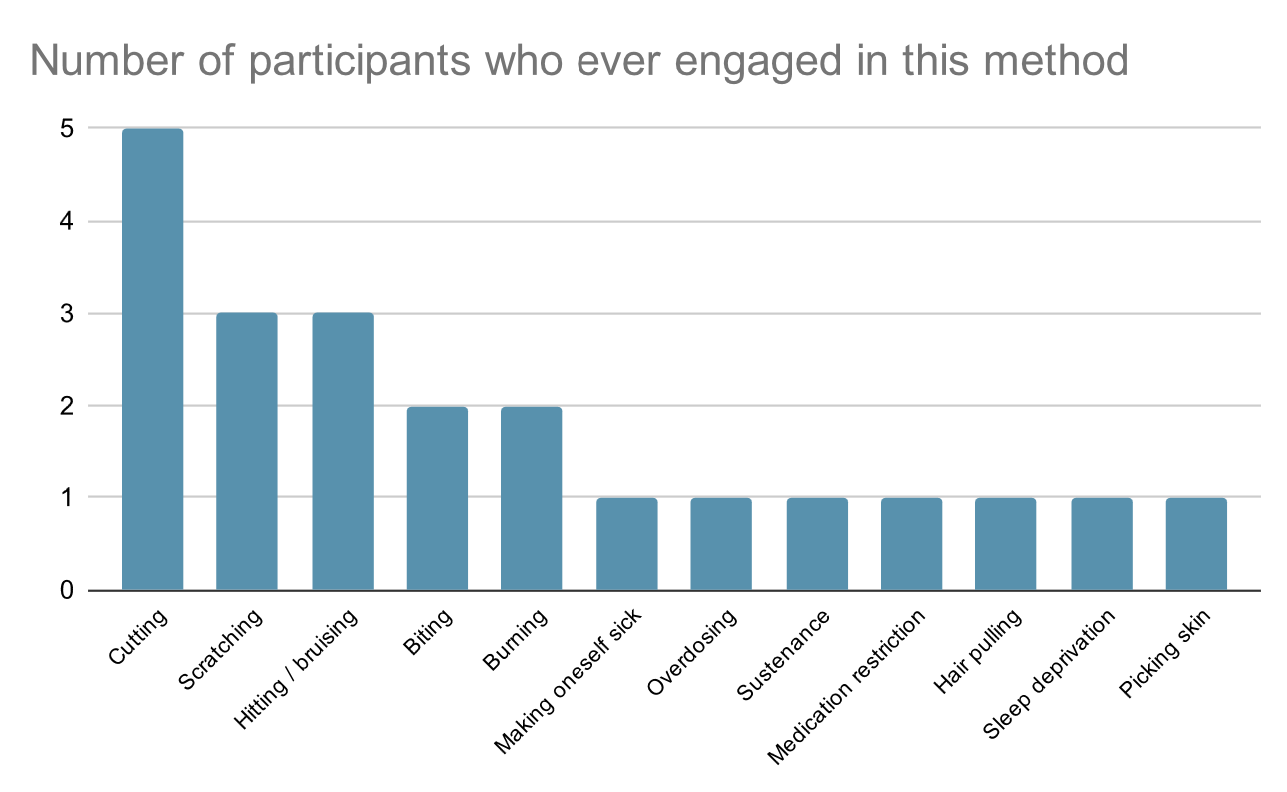
We identified the following codes throughout the interviews: “accessibility of tools”, “safety”, “social impact”, “functions of self-injury”, “sensory and physical results of self-injury”, “habituation”, “mental health”, “exposure to self-harm”, “location”, “social and familial context”, “adding, removing, or using several methods”, “upgrading a method”, and “experimentation”. “Safety” and “social impact” were later combined under the code “negative consequences”.
We then gathered these codes in five different categories: “practicality”, “efficiency”, “severity”, “context”, and “evolution in the use of methods”. See Figure 2 for the categorization of codes.
| Practicality | Efficiency | Severity | Context | Evolution |
| Accessibility of tools Negative consequences | Functions of self-injury Sensory and physical results of self-injury | Habituation Upgrading a method Mental health | Exposure to self-harm Location Social and familial context | Adding, removing, or using several methods Experimentation |
Figure 2 – Categories and codes
Practicality and context
Practicality was a topic frequently mentioned by participants. We defined practicality as factors that make the use of a method a suitable or not option for an individual in a given context. Context can include, but is not limited to, family and social life, location, and exposure to self-harm. The two main practical factors were the accessibility of means to self-injure, and the avoidance of negative consequences.
Access to both tools and the very idea of self-injury was determined by the context participants were in. Methods of onset reported by the participants were often accessible to a child or a teenager, such as their own hands, school equipment, or objects that could be found in their household. For example, Natalie, a 31-year-old woman, began by scratching, biting, and hitting herself with hard objects when she was about 5 or 6. Alex, a 33 queer participant, started cutting themselves with a handsaw during woodwork class at school, and then with a compass which was in their pencil case when they were about 12. Bree, a 25-year-old genderfluid participant, used a pair of eyebrow scissors he found in the bathroom when he cut himself for the first time at the age of 16 or 17.
Accessibility remains important for some participants later in life. For example, some engage in alternative methods when they do not have easy access to tools. Bill, a 22-year-old man who exclusively uses cutting, reports how he used burning instead twice:
“In both cases I didn’t have any blade nearby but there was a small box of matches” – Bill
People may also use alternative methods when they are in public. Sasha, a 28-year-old non-binary participant, explains their choice of methods vary depending on where they are:
“it depends on where I am. I prefer to cut because it is way more satisfying, but if I am out of home I usually pick the skin of my wrist with nails, or byte the inside of my cheeck with teeth” – Sasha
The location and the age of individuals therefore can have a role in the discovery and accessibility of a method.
In addition to having access to tools, getting the idea of NSSI is required to start engaging in the behavior. However, this idea does not necessarily stem from any external influence, as some participants were unaware of the concept of self-injury when they started engaging in it. This shows that NSSI does not always spread through contagion and mimicking.
“I discovered it myself definitely. I had no idea what ‘self harm’ was or that it is something that other people do until I got older. It started very much as something compulsive I did when I was overwhelmed as a child.” – Natalie
Other participants on the other hand reported having discovered self-injury through external influence, particularly on the Internet or acquaintances.
“Around 16 I started following a lot of depressing contents online about depression, suicide and eating disorders and I find out self harm on tumblr and I gave it a try” – Sasha
“I knew some people online who were doing it and who sometimes sent photos of their injuries […] It probably introduced the idea to me and made it seem less extreme than it might’ve seemed otherwise” – Bill
Interestingly, Bill’s main method of self-injury, cutting, is also the one that his online acquaintances predominantly used. This suggests that for some individuals the method used by acquaintances may directly influence the choice of method of an individual.
While Bree discovered cutting himself, he discovered another method of self-injury through online research. However the method was not effective enough for him to adopt it. We will develop the efficiency of NSSI below.
“I was looking online about what I did and why it helped calm me down, and I learned that self-harm was actually a pretty common thing. That comforted me too, to know I was not alone. So, I looked into what other options there were, and thought that bruising would be the best. Tried it for a bit, but then it couldn’t come close to how the cut felt.” – Bree
Most participants also reported taking into account potential negative consequences of self-injury in their choice of methods. Some methods may leave injuries that require more care, and therefore are avoided by some individuals.
“cutting at least doesn’t sting for a while afterwards and leave a blister.” – Bill
Methods also vary in severity and some can have more risks on health, possibly leading to severe injuries, hospitalization, or infections. Sasha started taking precautions when engaging in self-cutting, and prefers to engage in less risky methods when they are unable to use preventive measures:
“In the past I even [self-harmed] when I needed immediate release, but it was really dangerous because I didn’t clean my hands/the blade/the part of the body And I really can’t go to the hospital for an infection, so now I scratch when I need an immediate release and cut just after having cleaned my hands, the part of the body, the blade, and use a new blade every time” – Sasha
For Alex, hospitalizations for severe cuts contributed to making them use another method altogether:
“That would go on until I’d been to the hospital a few times and inevitably had a terrible experience. I know that I could so easily fall back into that again if I even start cutting myself “properly”, so I can’t let myself do that.” – Alex
“Another reason [bruising] didn’t work is because I was afraid of breaking my bones accidentally, it felt easier to do small damage with cutting than bruising […] (mainly because I was too scared to commit to hitting hard enough to doing the damage needed to achieve the intended pain response – I was very concerned with breaking anything under the muscle)” – Bree
Self-injury can also have social consequences, for example if discovered by others. The risk can be increased in communities and families in which stigma surrounding mental health is higher. For this reason, scarring was often a matter of concern for participants who sometimes bear permanent scars resulting from past self-injury. Alex’s concern about scars influenced their avoidance of some methods:
“If I am particularly worried about scarring, or someone seeing my self-harm, which was the case with my parents and teachers when I was a child and with my partner now, then I will avoid cutting/burning etc. as much as possible.” – Alex
While Sasha and Bree reported similar concerns about scars, it was not enough to stop engaging in cutting, and they prefer to conceal the scars or avoid situations in which they could be seen:
“I always cover my scars, I wear long sleeves and trousers even in summer and I don’t go to the beach since 2015 […] Even around my parents I always wear long clothes, even if it’s august with 35 degrees. […] I didn’t stop [self-harming] even because my scars are that bad that I’ll have them all my life, so there is no point in stopping this, even if I stopped I could’n wear t shirts, so why should I?” – Sasha
“It’s interesting, because in the moment, I would choose location based off of ideal pain level, but then if it was too visible, I would go to great lengths to hide it. With my very close and friends and family, I wouldn’t hide it as hard, but I never bring attention to it intentionally” – Bree
Bree does not feel the need to hide his scars among his close friends and family, which suggests that having an accepting and nonjudgmental social circle can help feel more comfortable about scarring.
Other people may not be concerned about scars at all:
“I don’t mind them except for the looks that others can give you if they see them. Except for that I don’t think anything of them really.” – Bill
Results show that practicality played an important role in participants’ choice of method, particularly in relation to their context. Their age, location, and social and familial surroundings impacted their ability to access some tools, or increased the risk of negative consequences on their health or social life. However, practicality was not always an impediment nor an enabler on its own, as another important factor for participants was efficiency.
Efficiency
For participants, their choice of methods was not only influenced by practicality, but was rather often the result of a balance, or a bargain, between practicality and what many call “efficiency”, the ability of a method to achieve the desired functions and sensations. For instance, Natalie uses scratching and hitting, which she considers safer than cutting, because they remain as effective to her. She might not have selected these methods had they not enabled her to gain as much relief:
“They are often also safer for me than something like cutting, while providing more or the same level of relief with lower risk.” – Natalie
Efficiency can rely on sensations experienced during the act of self-injury, such as pain or the sight of blood. These sensations vary per method, as not all methods generate the same type of pain for example.
“[…] cutting provides a more immediate relief – maybe the danger of it and the sight of immediate blood elicits an instantaneous and potent sense of relief. Scratching, on the other hand usually works for longer (it hurts more for much longer), and also therefore leaves me less likely to self injure again soon after – reasons why its a preferred method.” – Natalie
“[…] with cutting the pain is immediate but only for a moment whereas with burning it lingers and stings for a while afterwards, in my experience.” – Bill
Such testimonies show that pain plays an essential role in self-injury for some individuals. Bree explains he would feel “at-peace” afterwards, a feeling that he attributes to pain.
“The at-peace feeling would last for the rest of the day and the following day (since they would sting in the shower, the feeling would come back). I would be unlikely to harm again during that time. But once the cuts scabbed over and stopped hurting as much (which would on average be on the third day, since I would treat the wounds with medicine on the second day most of the time), then I would feel the urge again and the peaceful feeling would go away.” – Bree
For some participants, blood was an important aspect of self-injury.
“the sight of blood is really important” – Sasha
“the point of cutting is more for the bleeding, which you don’t get with burning. […] I’d let gravity make my wrist bleed more than it probably would otherwise, till it dripped onto the floor. It was relaxing to see the blood” – Bill
The importance of bleeding suggests the visual aspect of self-injury can be significant to some. For example, Bree tried bruising when he first started engaging in self-injury, but switched to cutting as the method was more effective to him.
“I preferred cutting mainly for the visual appeal. I was not able to hit hard enough to have a bruise that looked the way I wanted, but with cutting, the scratches would stay for at least several days. I know that after I would cut myself, I would just stare at the wound for long periods of time, almost entranced” – Bree
Individuals who engage in multiple forms of self-injury may be aware of these different sensations and results, and they can develop knowledge and experience in how to obtain the exact sensations they seek:
“With plastic razors you just get scratches that don’t scar because aren’t deep nor wide, even if they sting A LOT, wich was good. With blades alone is more effective and satisfying because cuts are deep, large and bleed a lot, and they always scar because the sides of the cut are apart, but they hurt less because the blade passes almost immediately the part of the skin with the nerves” – Sasha
“I always felt very at-peace, and in-control when I looked at the wounds. […] I also tend to do very thin and precise lines, so there’s an element of appreciation for how clean the cuts are and a fascination with how the skin pulls apart too” – Bree
Some individuals may also seek several sensations simultaneously in self-injury. For instance, Bree requires pain and sight to feel relieved.
“Which is why bruising didn’t end up working for me, because it didn’t look the way I wanted even if it hurt.” – Bree
For some individuals, a sensation can hold so much importance that the mere thought of it can elicit similar results as self-injury.
“The pain is a massive aspect for me, […] the anticipation of pain, I think, can help immediately” – Natalie
Efficiency also depends on the functions that self-injury has for an individual, such as expressing overwhelming emotions. Cutting for instance, can be a means of expression through carving words or symbols onto the skin:
“I went over the same scratch until it bled. I made a small line and also a heart shape.” – Alex
Furthermore, others grant importance to scars, and therefore seek methods that will cause scarring. In this case, scarring is not seen as a negative consequence of self-injury, but rather as an intentional result. Sasha sees their scars as an evidence for their mental health issues, a form of validation:
“I need the cut to become a scar, unless it seems not real and when it vanishes I feel like I have no proof that I am not ok” – Sasha
“Once the wounds were fully healed as a little scar, then the at-peace feeling would return, but to a much lesser degree, and I would also feel shame” – Bree
Participants’ insight suggest that for individuals, efficiency of self-injury may rely on sensations (such as pain), or visual results (such as blood or scarring). The desired physical or visual result may impact the choice of a method.
Severity
Participants exhibited signs of an increase in the severity of their self-injury at some point in their life. For several participants, this manifested as the gradual increase in the number of methods, sometimes even used simultaneously as reported by Alex:
“Sometimes I will switch methods to cause as much “harm” as possible at the time.” – Alex
As they repeatedly engage in self-injury, or as their mental health worsens, some participants’ use a method with increased severity to compensate for a decreasing efficiency. This is known as habituation. For example, Alex’s cutting became more frequent and more severe overtime:
“I’m definitely more attached to cutting. I used this method exclusively for a long time, and at times it progressed severely. I would get into a cycle where every time I cut it needed to be worse than the last time, and I had some horrible intrusive thoughts all the time about it.” – Alex
Other participants upgraded their methods of self-injury to cause more harm. For instance, Sasha kept using cutting as their preferred method but changed tools to do so, which coincided with a worsening of their mental health and a traumatic event in their life:
“At the time when I began I cut but with plastic razors, so it wasn’t that bad, just superficial scratches Then at 20 it went bad and I changed method […] I started dismantling plastic razors and using just the blades that are way more effective Years later I discovered blades alone existed and I started buying them” – Sasha
Evolution in the use of methods and balance
While participants engaged in multiple methods of self-harm, they all reported having a main or preferred method. However, the range of methods used by each participant was not unchangeable: methods could be added or removed throughout time. For instance, Natalie explains the evolution of her use of methods:
“my current main form of self injury is scratching, and occasionally I hit myself but no biting [anymore]. I do also occasionally cut now, which I never did as a child.” – Natalie
Sometimes, a method had to be replaced by another one, for practical reasons. For instance, Alex stopped cutting, but used other methods as an alternative:
“these days there’s a *lot* of trying not to do that, so hurting myself in other ways like scratching, hitting things” – Alex
Exposure to another form of self-injury made Bill curious about this method:
“How different the feeling would be compared to cutting, and I remembered someone I knew who self harmed had used [burning] which made me a bit more curious” – Bill
This shows that a desire to experiment can also influence the choice of a method.
Discussion
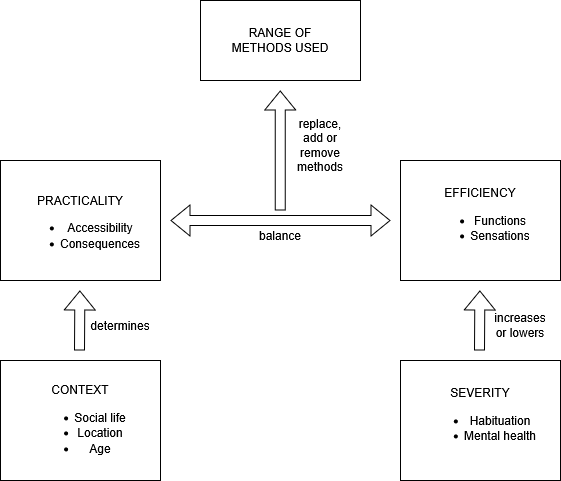
As explained in the results section, the choice of methods of self-injury appears to result from the balance between practicality (accessibility and avoidance of negative consequences) and efficiency (determined by the function and sensations sought). While practicality is determined by the context in which individuals live, efficiency can be increased or lowered by habituation and the mental health of individuals. Each factor can have more or less importance for individuals. For instance, while Alex stopped cutting to avoid scarring, Sasha preferred to keep cutting and hide their scars instead. To summarize the role of each factor in impacting the choice of a method, we propose the following preliminary model displayed in Figure 3.
The results of this study are supported by previous research. The importance individuals attach to some sensations has been established by prior studies. For instance, participants in the present study reported attaching importance to blood, scars, and pain, which is consistent with current findings to date. About 40% to 50% of people who engage in self-injury report blood being important to them (Favazza & Conterio, 1989; Glenn & Klonsky, 2010; Kandeger et al., 2024).
Lewis & Mehrabkhani (2016) have shown that some individuals with self-injury can find scars comforting and consider them a proof of the suffering they endured. The visual aspect of self-injury might play an important part as it turns something abstract, emotional pain, into something concrete and visible, like a scar or an injury (Chandler, 2012; Sternudd, 2010). However, people with self-injury often regard their scars with ambivalence (Sternudd, 2012) and many individuals attempt to keep them hidden, either covering them, avoiding situations in which they could be visible or by resorting to “cover stories” when their scars get noticed (Lewis, 2016; Lewis & Mehrabkhani, 2016). This ambivalence has been displayed in our study, as scarring could be both a negative result from self-injury, and something sought for.
Pain was also an important factor for most of our participants. The concept of pain in self-injury has been widely discussed in academic literature, and yet research remains inconsistent – revolving mainly around measuring the experience of pain in people with self-injury. A 2010 study suggests that people who engage in self-injury have higher pain tolerance than those who do not (McCoy et al., 2010). Joiner’s interpersonal theory of suicide proposes that repeated self-injury desensitizes to pain and the fear of pain, which could explain such increased pain tolerance (Joiner, 2007; Joiner et al., 2012). However, individuals in the present study often reported choosing methods that are more painful to them, which suggests that analgesia in self-injury might be interpreted with nuance. This is consistent with Amy Chandler’s findings that while some individuals did indeed feel no pain during an act of self-injury, others not only felt pain, but attach great importance to it (Chandler, 2012).
While practicality has rarely been discussed in regard to the choice of methods of self-injury, its impact has been shown in studies about suicide method. In a study about self-immolation in Iran, Rezaie et al., (2014) have suggested that easy access to kerosene could contribute to the high prevalence of this suicide method, when combined with other factors. Previous research has also shown that practicality can influence the choice of body parts in self-injury. While individuals who engage in self-injury have reported doing so in multiple locations on the body (Sornberger et al., 2012), self-injury is predominantly done on the arms, which are easily reachable, concealable, with low-mortality and fast-healing rates (Seko, 2013). This suggests that self-injury location might sometimes be a conscious practical choice. The current research has found similar findings about the choice of methods of self-injury, with participants assessing risks on their health and social life.
Conclusion
Limits
The current study is explorative and its results need to be interpreted with caution. Results should be further investigated and validated with larger samples and quantitative data. Furthermore, testimonies are subjective, and participants may not always be able to fully understand their own behavior. It is also possible that participants withdrew some information due to the sensitive nature of the topic. Specific care was given to foster a safe environment in which participants could express themselves freely and comfortably. While most participants expressed their confidence in talking about self-injury, one participant felt talking about such a specific topic was unusual to them, as talk about precise methods is banned on most online communities. In his interviews with individuals who engage in self-injury, Brossard (2018) has noticed that participants were reluctant to talk about the ritualistic aspects of the behavior. This suggests that while self-injury itself is sensitive, some aspects of it might be further stigmatized.
Furthermore, we did not ask participants for their nationality nor ethnicity, and it is possible that culture had an impact on their choice of methods.
We did not screen participants for psychiatric disorders, but it is possible that such factors could play a role in the choice of methods.
Finally, this research studied an adult population, and the results may not apply to an adolescent population.
Implications
Nevertheless, the current study adds new findings to the currently scarce literature about methods of self-injury. Important elements were identified and are consistent with previous studies, such as the role of scarring, pain, or negative consequences of self-injury. Nevertheless, to the best of our knowledge the current study is the first to draw connections between these elements, and to suggest their influence in the choice of a self-injury method. Furthermore, participants were adults, and a rather large portion came from sexual or gender minorities, two populations that are often understudied.
This study has several implications. First it suggests that the choice of a self-injury method is often the result of a balance between several factors, and may not always be the preferred choice of an individual. Therefore, preventing an individual from injuring themselves, for example by taking their tools, without additional support or treatment, might not be effective as it could lead to a change in methods. For instance, cessation of cutting may not be a sign of recovery, but could indicate a change of method that would be better adapted to the individual’s current balance between practicality and efficiency. Secondarily, it reveals that self-injury and self-harm can take many forms, some being common (cutting, burning, or scratching), and some being less reported, such as medication restriction, or sleep deprivation. It is important to keep an open-mind in regard to forms of self-harm, in order to detect individuals at risk.
This research leaves some questions unanswered. For instance, our findings do not explain the differences between males and females regarding their choice of self-injury. It is possible that the different experiences between genders influence factors such as the context and severity. This aspect therefore requires further studies.
Properly understanding factors, personal preferences, and functions associated with a specific method may enable professionals to adapt treatment more precisely to patients’ needs.
References
American Psychiatric Association. (2013). Diagnostic and Statistical Manual of Mental Disorders: DSM-5. American Psychiatric Association.
Ammerman, B. A., Hong, M., Sorgi, K., Park, Y., Jacobucci, R., & McCloskey, M. S. (2019). An examination of individual forms of nonsuicidal self-injury. Psychiatry Research, 278, 268-274. https://doi.org/10.1016/j.psychres.2019.06.029
Andover, M. S., Primack, J. M., Gibb, B. E., & Pepper, C. M. (2010). An Examination of Non-Suicidal Self-Injury in Men: Do Men Differ From Women in Basic NSSI Characteristics? Archives of Suicide Research, 14(1), 79-88. https://doi.org/10.1080/13811110903479086
Baer, M. M., Tull, M. T., Forbes, C. N., Richmond, J. R., & Gratz, K. L. (2019). Methods Matter: Nonsuicidal Self-Injury in the Form of Cutting is Uniquely Associated with Suicide Attempt Severity in Patients with Substance Use Disorders. Suicide Life Threat Behav, 50(2), 397–407. https://doi.org/10.1111/sltb.12596
Baker, T. G., & Lewis, S. P. (2013). Responses to Online Photographs of Non-Suicidal Self-Injury: A Thematic Analysis. Archives of Suicide Research, 17(3), 223-235. https://doi.org/10.1080/13811118.2013.805642
Brausch, A. M., Williams, A. G., & Cox, E. M. (2016). Examining Intent to Die and Methods for Nonsuicidal Self-Injury and Suicide Attempts. Suicide and Life-Threatening Behavior, 46(6), 737-744. https://doi.org/10.1111/sltb.12262
Brossard, B. (2018). Why Do We Hurt Ourselves? Understanding Self-Harm in Social Life. Indiana University Press.
Chandler, A. (2012). Inviting pain? Pain, dualism and embodiment in narratives of self-injury. Sociology of Health & Illness, 35(5), 716-730. https://doi.org/10.1111/j.1467-9566.2012.01523.x
Favazza, A. F., & Conterio, K. (1989). Female habitual self mutilators. Acta Psychiatrica Scandinavica, 79(3), 283-289. https://doi.org/10.1111/j.1600-0447.1989.tb10259.x
Franzén, A. G., & Gottzén, L. (2011). The beauty of blood? Self-injury and ambivalence in an Internet community. Journal of Youth Studies, 14(3), 279-294. https://doi.org/10.1080/13676261.2010.533755
Glenn, C. R., & Klonsky, E. D. (2009). Social context during non-suicidal self-injury indicates suicide risk. Personality and Individual Differences, 46(1), 25-29. https://doi.org/10.1016/j.paid.2008.08.020
Glenn, C. R., & Klonsky, E. D. (2010). The Role of seeing blood in non-suicidal self-injury. Journal of Clinical Psychology, 66(4), 466-473. https://doi.org/10.1002/jclp.20661
Gunawan, J., Marzilli, C., & Aungsuroch, Y. (2022). Online ‘chatting’ interviews: An acceptable method for qualitative data collection. Belintung Nursing Journal, 8(4), 277-279. https://doi.org/10.33546/bnj.2252
Joiner, T. (2007). Why People Die by Suicide. Harvard University Press.
Joiner, T. E., Ribeiro, J. D., & Silva, C. (2012). Nonsuicidal Self-Injury, Suicidal Behavior, and Their Co-occurrence as Viewed Through the Lens of the Interpersonal Theory of Suicide. Current Directions in Psychological Science, 21(5), 342-347. https://www.jstor.org/stable/44318606
Kandeger, A., Uygur, O. F., Ataslar, E. Y., & Selvi, Y. (2024). A pilot study examining hemomania behaviors in psychiatry outpatients engaged with nonsuicidal self-injury. Brain and Behavior, 14(4). https://doi.org/10.1002/brb3.3475
Lewis, S. P. (2016). The Overlooked Role of Self-injury Scars: Commentary and Suggestions for Clinical Practice. The journal of nervous and mental disease, 204(1), 33-35. https://doi.org/10.1097/nmd.0000000000000436
Lewis, S. P., & Hasking, P. A. (2023). Understanding Self-Injury: A Person-Centered Approach. Oxford University Press.
Lewis, S. P., & Mehrabkhani, S. (2016). Every scar tells a story: Insight into people’s self-injury scar experiences. Counselling Psychology Quarterly, 29(3), 296-310. https://doi.org/10.1080/09515070.2015.1088431
Malterud, K., Siersma, V. D., & Guassora, A. D. (2016). Sample Size in Qualitative Interview Studies: Guided by Information Power. Qualitative Health Research, 26(13), 1753-1760. https://doi.org/10.1177/1049732315617444
Matsumoto, T., Yamaguchi, A., Chiba, Y., Asami, T., Iseki, E., & Hirayasu, Y. (2005). Self-burning versus self-cutting: Patterns and implications of self-mutilation; a preliminary study of differences between self-cutting and self-burning in a Japanese juvenile detention center. Psychiatry and Clinical Neurosciences, 59(1), 62-69. https://doi.org/10.1111/j.1440-1819.2005.01333.x
McCoy, K., Fremouw, W., & McNeil, D. W. (2010). Thresholds and tolerance of physical pain among young adults who self-injure. Pain Res Manag, 15(6), 371–377. https://doi.org/10.1155/2010/326507
Rezaie, L., Hosseini, S. A., Rassafiani, M., Najafi, F., Shakeri, J., & Khankeh, H. R. (2014). Why self-immolation? A qualitative exploration of the motives for attempting suicide by self-immolation. Burns, 40(2), 319-327. https://doi.org/10.1016/j.burns.2013.06.016
Robertson, C. D., Miskey, H., Mitchell, J., & Nelson-Gray, R. (2013). Variety of self-injury: is the number of different methods of non-suicidal self-injury related to personality, psychopathology, or functions of self-injury? Archives of suicide research, 17(1), 33-40. https://doi.org/10.1080/13811118.2013.748410
Seko, Y. (2013). Picturesque Wounds: A Multimodal Analysis of Self-Injury Photographs on Flickr. Forum Qualitative Sozialforschung Forum: Qualitative Social Research, 14(2). https://doi.org/10.17169/fqs-14.2.1935
Selby, E. A., Nock, M. K., & Kranzler, A. (2014). How does self-injury feel? Examining automatic positive reinforcement in adolescent self-injurers with experience sampling. Psychiatry Research, 215(2), 417-423. https://doi.org/10.1016/j.psychres.2013.12.005
Sornberger, M. J., Heath, N. L., Toste, J. R., & McLouth, R. (2012). Nonsuicidal self-injury and gender: patterns of prevalence, methods, and locations among adolescents. Suicide and Life-Threatening Behavior, 42(3), 266-278. https://doi.org/10.1111/j.1943-278x.2012.0088.x
Sternudd, H. T. (2010). The Discourse of Cutting: A Study of Visual Representations of Self-Injury on the Internet. In J. Fernandez (Ed.), Making Sense of Pain: Critical and Interdisciplinary Perspectives (pp. 237-248). Brill. https://doi.org/10.1163/9781848880368_024
Sternudd, H. T. (2012). Photographs of self-injury: production and reception in a group of self-injurers. Journal of Youth Studies, 15(4), 421-436. https://doi.org/10.1080/13676261.2012.663894
Taylor, P. J., Jomar, K., Dhingra, K., Forrester, R., Shahmalak, U., & Dickson, J. M. (2018). A meta-analysis of the prevalence of different functions of non-suicidal self-injury. Journal of Affective Disorders, 227, 759-769. https://doi.org/10.1016/j.jad.2017.11.073
Tilton-Weaver, L. C., Marshall, S. K., & Svensson, Y. (2025). Examining the Methods Adolescents Use in Nonsuicidal Self-Injury: A Multi-Wave Latent Profile Analysis. Journal of Adolescence, 1-17. https://doi.org/10.1002/jad.12516
Turner, B. J., Layden, B. K., Butler, S. M., & Chapman, A. L. (2013). How Often, or How Many Ways: Clarifying the Relationship Between Non-Suicidal Self-Injury and Suicidality. Archives of Suicide Research, 17(4), 397-415. https://doi.org/10.1080/13811118.2013.802660
Victor, S. E., & Klonsky, E. D. (2014). Correlates of suicide attempts among self-injurers: A meta-analysis. Clinical Psychology Review, 34(4), 282-297. https://doi.org/10.1016/j.cpr.2014.03.005
Westers, N. J. (2024). Cultural interpretations of nonsuicidal self-injury and suicide: Insights from around the world. Clinical Child Psychology and Psychiatry, 29(4), 1231-1235. https://doi.org/10.1177/13591045241287249
Whitlock, J., Muehlenkamp, J., Eckenrode, J., Purrington, A., Abrams, G. B., Barreira, P., & Kress, V. (2013). Nonsuicidal Self-Injury as a Gateway to Suicide in Young Adults. Journal of Adolescent Health, 52(4), 486-492. https://doi.org/10.1016/j.jadohealth.2012.09.010
Whitlock, J., Muehlenkamp, J., Purington, A., Eckenrode, J., Barreira, P., Abrams, G. B., Marchell, T., Kress, V., Girard, K., Chin, C., & Knox, K. (2011). Nonsuicidal Self-injury in a College Population: General Trends and Sex Differences. Journal of American College Health, 59(8), 691-698. https://doi.org/10.1080/07448481.2010.529626

