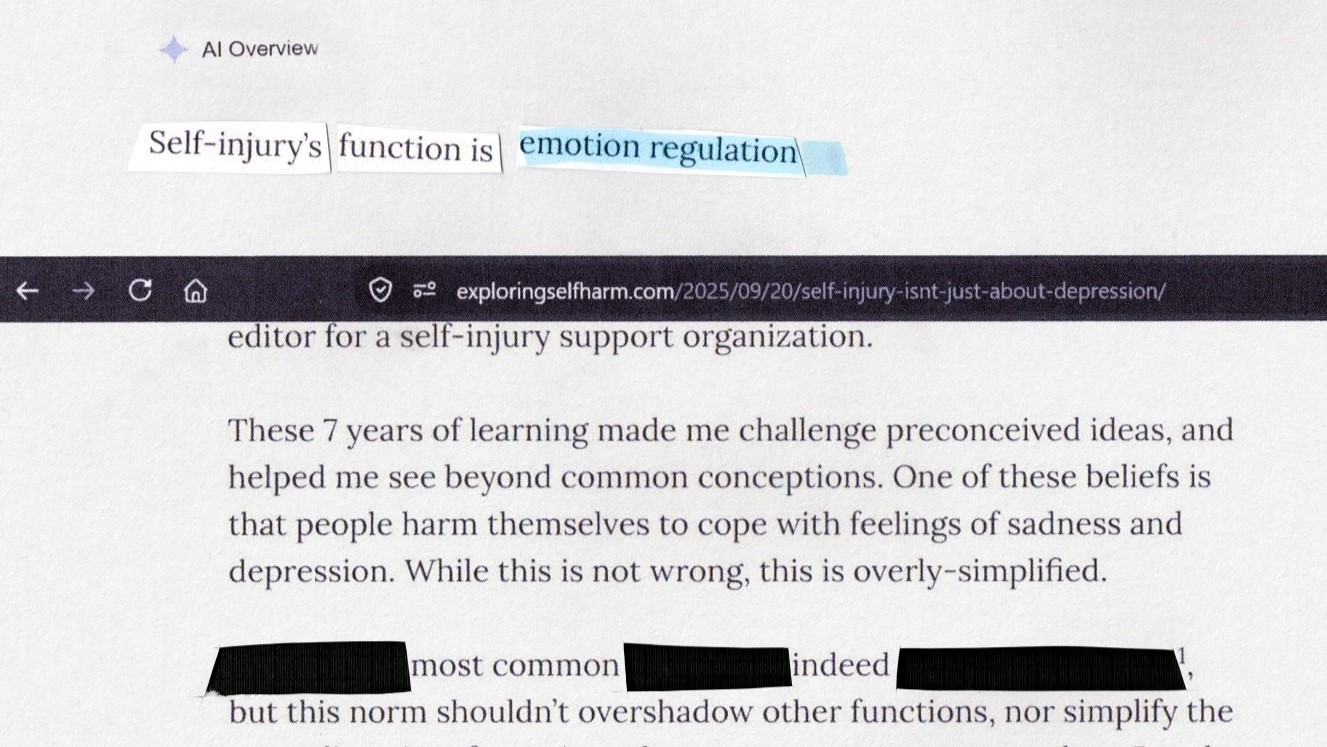
When I write an article, I write keeping my reader in mind. I ask myself what audience I am trying to reach, but also whether the person who will read this could be struggling with mental health issues. This is important given the sensitive nature of this website. I do my best to write responsibly, to avoid unnecessary triggering words or descriptions. And yet, I also know that some people who struggle with self-injury may not recognize themselves in the many articles that tiptoe around the topic, and so I try to cover what’s often left unsaid, to tackle taboos. I recall a reader who told me they enjoyed my article about blood, and felt relieved to learn they weren’t alone feeling that way. It made my day, because it is for this type of person I write.
Recently though, Google has launched its AI Overview tool on their search result pages in France. Apparently the feature was already in use in other countries for months which I wasn’t aware of. It uses websites’ content to give users an answer to their search. The tool is handy, and can avoid wasting time. I appreciate that it at least sources the website used, but I guess many people are satisfied enough with the result they get and don’t search further. But there lies the problem, if people do not visit websites anymore, what is the point of writing them? I write to readers, not to feed a bot, let alone that of a tech giant who’ll use my content for free. If writers, artists, video makers who publish content online stop getting an audience, they’ll get discouraged and stop creating content.
On Google Search Console, I can see how people find my website: what they searched online when they were recommended one of my articles. Many searches revolve around Richey Edwards and the 4REAL incident. When I search the exact same terms some of my readers search, I now get the AI Overview.
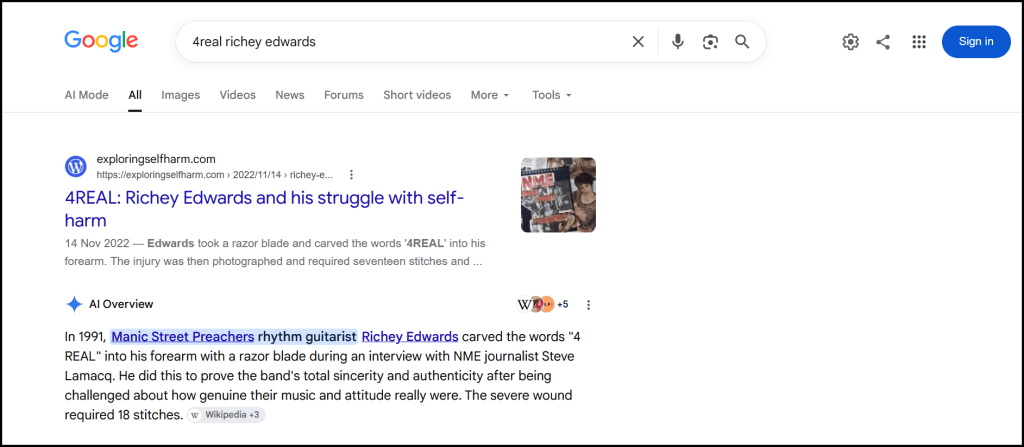
The AI Overview uses my article as a source. Would you click on the link to read more? I don’t aim to guilt-trip anyone here: I admit, AI is handy, and I use it to proofread my articles when no-one else is available. And while I make sure to always skip the AI Overview when I search online, I am not sure I would have this insight if I wasn’t also a writer.
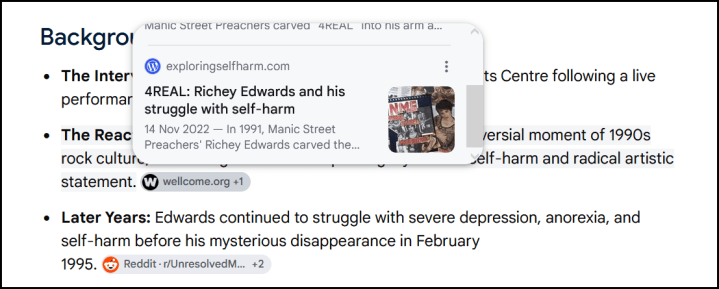
But what will become of the internet if we stop contributing to it? Do we really want a search engine with three tabs: images, AI, and social media? One in which the vast library of preexisting websites is kept hidden, inaccessible, and where we lose the ability to pick and choose which website pages we read. It’s not just about Google’s AI Overview, it’s also about our use of ChatGPT and other AI assistants.
But the harm potentially goes even further: in a time when everything goes fast, videos turn into reels and shorts, and we get instant information, should all articles be kept short and excessively easy to read? When we read an article, we take time to learn more than the mere information we were looking for, to see the world through the eyes of someone else, and to challenge our opinion.
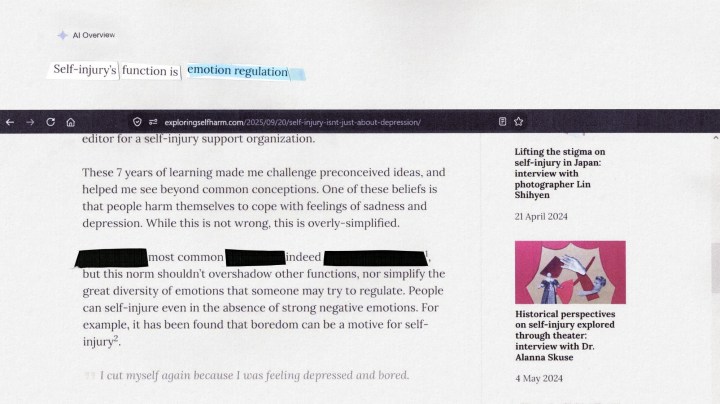
And challenging our opinion also goes through challenging taboos, something which the AI Overview does not. Unlike the search about Richey Edwards, other searches about self-injury render no overview by the AI tool. This is maybe preferable, given the many tragedies that occurred over the past few years, with the role of AI assistants being questioned in some suicide cases. Faced with the failures of AI chats to tackle sensitive topics in a safe way, it appears many AI companies preferred to block any discussion about self-harm completely, leaving people who open up to these non-human assistants with their questions unanswered. Clearly AI companies will have to think about how to provide safe and reliable information about mental health. Information that neither glamorizes nor censors self-injury.
It is too early for me to see if my website receives less visits since the AI Overview featured was released, and this is not what matters to me anyway. I’ve always preferred quality over quantity. But what matters to me is to be read by actual humans and to feel I have been useful, even for just one person.
 Exploring self-harm