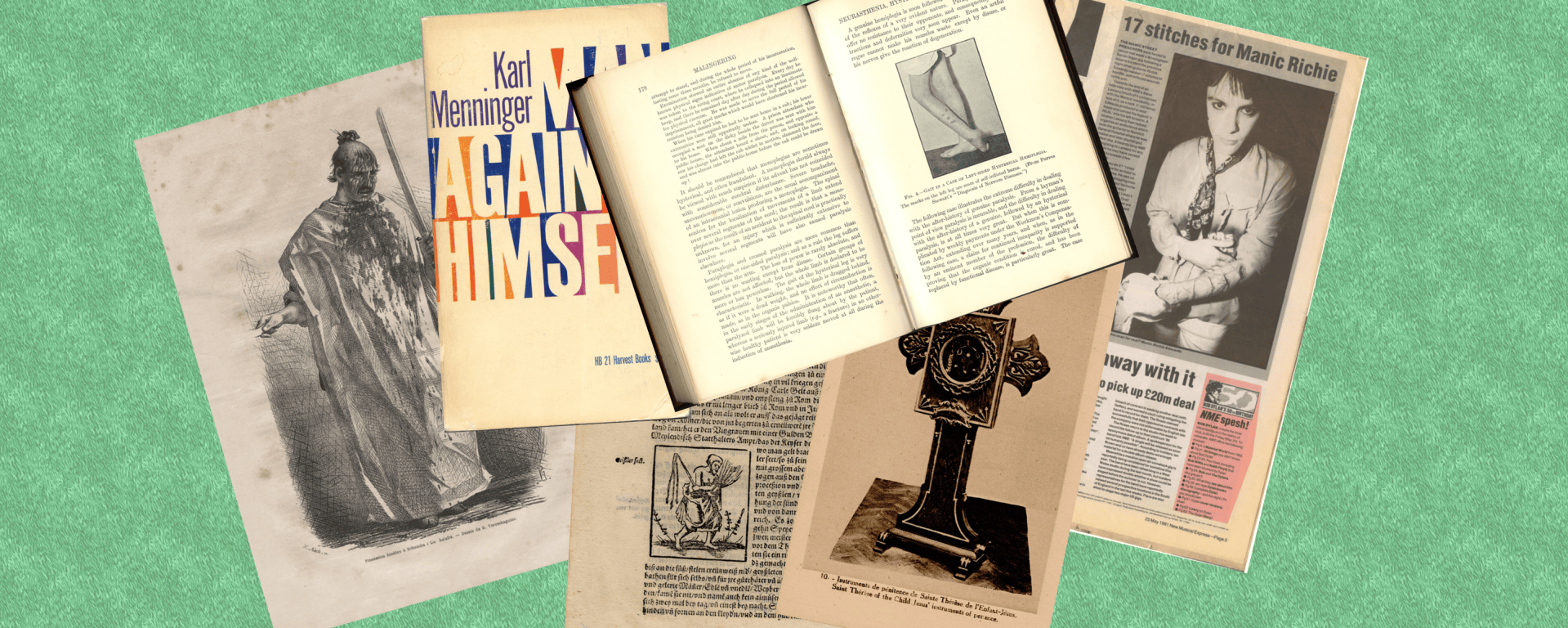
Seven years ago, I created this website to cover non-suicidal self-injury. But very quickly my interests expanded and included other forms of self-injury, such as religious self-harm throughout cultures and history, or self-inflicted wounds in the military.
What is non-suicidal self-injury?
Non-suicidal self-injury, also known as NSSI, is the repetitive self-infliction of injury in order to induce a positive state or reduce negative feelings, in a way that is neither socially sanctioned nor motivated by sexual or aesthetic reasons1, 2
Of course, these are very different types of harm to the self, and we can’t treat them the same way we would NSSI. Religious self-flagellation in history can’t be seen as a sign of mental health issues for example. Not only would it be wrong, but it would also minimize and ignore the many reasons that can push someone to harm themselves.
Historians and psychiatrists have proven that we can’t see self-harm as a global concept, one that would be universal through time and space3. And yet, at times in history, attempts to explain self-harm have been made by drawing comparisons with multiple forms.
In the 19th century for example, some alienists made a parallel between the body modification of primitive societies and the mutilations some mentally ill patients were inflicting upon themselves. They believed self-mutilation was a trait of savage, uncivilized individuals, although this belief was not unanimous even at the time3 and has since been discredited. A similar comparison was made with criminals who often had tattoos and who were considered primitive as well4.
Another example: in the early 20th century, as fear of malingering grew, self-inflicted injury became associated with the idea of manipulation and the seeking of gain: attention for women, and financial or the avoidance of work for men. While once again this theory has since been disproved, the idea that non-suicidal self-injury is used to gain attention remains a persistent myth.
Learning about the history of self-harm isn’t needed to understand NSSI, but it enables us to grasp the evolution of our perception towards it. This is why, while NSSI remains my primary interest, I am curious about other forms of self-harm. To enable a broader audience to access material, I’ve digitized my collection and published it on archive.org. The collection will be updated gradually.
[1] American Psychiatric Association. (2013). Diagnostic and Statistical Manual of Mental Disorders: DSM-5. American Psychiatric Association.
[2] Trybou, V., Brossard, B., & Kédia, M. (2018). Automutilations: comprendre et soigner. Odile Jacob.
[3] Chaney, S. (2017). Psyche on the Skin: A History of Self-Harm. Reaktion Books.
[4] Guisy, M. (2023). Changer de peau: tatouages, piercings et scarifications, d’hier à aujourd’hui. Vendémiaire.

