Mental health struggles such as self-injury, anxiety or depression aren’t just passing issues. They are something people struggle with throughout months and years. And yet, seasonal events can still have an influence on well-being, and either improve or worsen the situation. We’ve already covered self-harm during the summer and the festive season. Now let’s explore how self-injury evolves during autumn and school months.
It isn’t easy to understand how self-injury evolves throughout the year because most incidents occur privately and go unnoticed. Cases that are known by professionals and researchers may be more severe than the ones that are kept private, and therefore may not be representative of the whole. But self-injury doesn’t happen in a vacuum; it’s tied to mental health issues. Other signs of mental health issues can help us understand how self-injury varies throughout the year.
Researchers from the universities of Oxford and Nottingham in the UK examined how mental health evolves throughout seasons. They analyzed data about more than 5 million teenagers and young adults in England, making it the largest study to date to explore this topic.
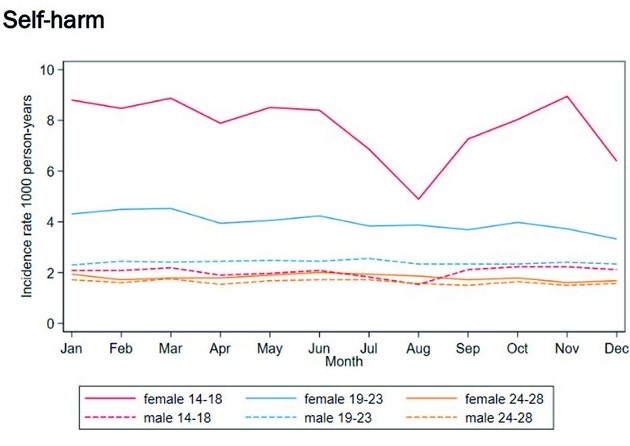
Overall, they didn’t notice an evolution of self-harm throughout the year, except that girls self-harmed less frequently during the summer. Let’s keep in mind that in the UK, self-harm doesn’t refer to self-injury only, but also includes self-poisoning and suicide attempts.
But the researchers noticed that mental health consultations, antidepressants prescriptions, and rates of depression and anxiety among teenagers increased during the autumn months.
This seasonal trend raises questions: why does this occur in autumn? The researchers suggest colder, darker weather, and daylight hours could affect teens’ mental health. School could also have a significant negative impact. In England, the new school year begins in September, and is interrupted by the first major break in December, coinciding with Autumn months.
This trend isn’t limited to England only, as findings from across the Atlantic support this idea. In 2024, worried about the impact of school on teens’ well-being, Wisconsin’s Department of Health Services (DHS) warned parents and caregivers to be aware of signs of self-injury after school breaks, in January and September2. This suggests that in the United States as well teens’ mental health appears to fluctuate throughout the year.
Consistent with the study we discussed above, the DHS found an increase of 40% in self-injury among youth in September 2022 and January 2023 compared to the preceding months. The increase was less drastic in September 2023 but still significant. Such an increase could be explained by the academic and social stress young people can experience when returning to school after breaks.
But we should be careful when interpreting these results. Most self-injury goes unnoticed and doesn’t lead to medical care. These studies can only use data from reported cases, which might be more severe or occasional. In the end, while we should be aware of specific times that may make teens more vulnerable, our vigilance and care should remain constant all year long.
If you found this article interesting and would like to learn more about how self-harm varies throughout seasons, I’ve also covered self-harm during the summer and during the festive season.
References
[1] Jack, R. H., Joseph, R. M., Hollis, C., Hippisley-Cox, J., Butler, D., Waldram, D., & Coupland, C. (2023). Seasonal trends in antidepressant prescribing, depression, anxiety and self-harm in adolescents and young adults: an open cohort study using English primary care data. BMJ Mental Health, 26(1), 1-6. http://dx.doi.org/10.1136/bmjment-2023-300855
[2] Wisconsin Department of Health Services. (2024, January 17). Health Agency Urges Parents, Caregivers to be Aware of Signs of Self-Harm After School Breaks. Wisconsin Department of Health Services. Retrieved January 21, 2024, from https://www.dhs.wisconsin.gov/news/releases/011724.htm
 Exploring self-harm