Most of mankind seeks to avoid suffering. Nowadays in particular, thanks to social and scientific progress, our lifestyle enables us to live relatively comfortably and diminish pain. In that regard, it can seem surprising at first that some cultures or communities would value pain. Christianity for instance, holds suffering in a positive light, at least in its moderate form. Suffering can be seen as a gift from God to remind people of the meaning of life, to atone for their sins and as a means to identify with Jesus Christ (Aguado, 1992).
Many Christian saints embraced this suffering. Martyrs for example, suffered tremendous pain and died for their faith. One such saint, while not a martyr, is Thérèse de Lisieux, whose autobiography Story of a Soul told the life of suffering, the spiritual journey, and defined a new spiritual approach, titled the “little way”: valuing simple, small expressions of love. Thérèse’s painful death from tuberculosis at the young age of 24 contributed to her notability. As we shall see, suffering plays a central role in Thérèse de Lisieux’s life and work, as testified by her use of vocabulary: the word “suffer” was used 228 times, and “suffering” 134 times (Descouvemont, 2022). Suffering, for Thérèse, had diverse values and meanings which this article will seek to define: from pain she inflicted unto herself through mortification, to suffering she accepted during illness.
Mortification
A duty in Carmel
Mortification is the act of causing harm to oneself, either physically or mentally, for religious reasons. We know the practice of mortification was encouraged in Carmel, as evidenced by reference books which state the set of rules and behaviors that carmelites were required to follow. One example of such reference books is the Paper of Exaction. In the 1889 edition, which was taught to Thérèse and which she later used to teach novices, mortification is mentioned in a chapter titled “Modesty and Mortification of the Senses”. Carmelites were requested to limit their comfort as a form of mortification.
“When they are sitting down in their cells, or during the offices, even when no-one can see them, they should not be lying down, nor be crooked, nor straighten their legs too much, but instead make sure that they are in an honest and modest way, which does not give too much comfort to the body which must always be mortified religiously.”
In one of her poems, Heaven is the price (PS 04), Thérèse reminds her reader, presumably young novices, that such mortification is one of the costs to enter Heaven.
“Heaven is the price
In my poor cell
No tulle curtains
Neither mirrors nor carpet.
Heaven is the price
Nothing, neither table nor chair
Being uncomfortable
That’s happiness here.”
Furthermore, carmelites were forbidden to complain about discomfort such as the cold, exhaustion, sickness or unpleasant food.
Another reference book, Spiritual direction, has an entire chapter dedicated to mortifications performed in the refectory, where most of these acts occurred. It lists that it is a custom to perform acts such as kissing other carmelites’ feet, bowing down or eating on the floor, begging, asking for forgiveness, or blindfolding themselves. However, carmelites were not to mortify as part of a habit or out of a desire to gain recognition.
In the Yellow Notebook, Pauline – Thérèse’s Sister, also known as Mother Agnès de Jésus – transcribed the last words of Thérèse in the months preceding her death. On September 2 1897, Thérèse mentioned her difficulties requesting the right to perform mortifications at the refectory due to her shyness.
“Asking to make mortifications in the refectory used to cost me dear, because I was shy, I would blush, but I was very faithful to my two times a week. Once this ordeal of shyness passed, I paid less attention to it and I must have forgotten my two mortifications more than once”.
Thérèse herself appeared to see suffering as having a valuable role at the Carmel. In letter 047 to her sister in 1888, she wrote “[a] Carmelite’s day spent without suffering is a wasted day”.
Physical vs mental mortification
Physical self-harm has been a long tradition in Christianity and many saints sought to inflict pain upon themselves for spiritual reasons. Thérèse performed physical mortification at Carmel. Marie de la Trinité wrote in a letter that “[t]he instruments of penance of [Sister] Thérèse [de l’Enfant-Jésus] consisted of 1 bracelet, 1 horsehair belt, 1 iron cross, 1 cilice. But don’t be alarmed, she hardly made use of them, her mortifications, as she says, consisted above all in mortifying her mind and her heart”. The report for the certification non-cultus corroborates this list, adding that the bracelet was “an iron mesh bracelet with spikes”, the cross was “a small iron mesh cross with spikes” and that Thérèse also owned a whip, known as a discipline. Céline, in her notes, reported how Thérèse did not avoid painful movements while wearing instruments of penance, believing there was no point in doing things by halves. She was reported as having said: “I take the discipline to hurt myself and I want it to hurt as much as possible”. Céline added that on some occasions the pain would bring tears to Thérèse’s eyes, but that she would hide the pain and smile through it, as she was happy to suffer. Thérèse admitted the cold was the most difficult mortification for her to endure at Carmel, but she would still bear it, arguing that there would be no use to choose an austere life if it is then to seek relief and comfort (Carnet rouge de Marie de la Trinité).
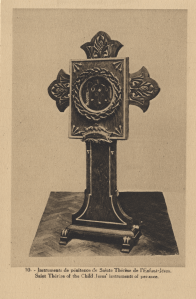
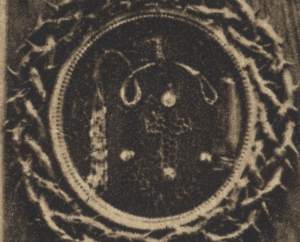
Despite such acts, Thérèse lacked interest in physical mortification, and was also forbidden to perform it due to her deteriorating health condition. As she was caught drinking a foul-tasting remedy slowly to extend the unpleasant moment, Thérèse remarked, reported in notes taken by her sister Céline: “Shouldn’t I take advantage of the little opportunities that comes across me to mortify myself a bit, since I’m forbidden to look for greater ones?”. These notes would later prove helpful during her process of beatification and canonization.
Thérèse expressed her preference for more symbolic forms of mortification several times throughout her autobiography Story of a Soul. In 1888 (Ms.A 68 v°), as she was waiting to enter Carmel, Thérèse decided to seek improvement, and to live a “mortified life”. However, she did not perform physical mortification, and saw her lack thereof as a potential sign of “cowardice”:
“Soon I understood the value of time that was given to me and I resolved to devote myself more than ever to a serious and mortified life. When I say mortified, it is not to make people think I was doing penances, alas! I have never done any, far from resembling the beautiful souls who since childhood has practiced all kinds of mortifications, I felt no attraction to them; no doubt it came from my cowardice, because, like Céline, I could have found a thousand little inventions to make myself suffer, instead I have always let myself be coddled in cotton and stuffed like a little bird that does not need to do penance… My mortifications consisted in breaking my will, always ready to impose itself, in holding back a riposte, in doing small favors without showing them off, in not leaning on my back when I was sitting, etc., etc. It was through the practice of these slightest things that I prepared myself to become the fiancée of Jesus”.
Later she reiterated her thoughts (Ms.A 74 v°):
“Love for mortification was also granted to me, it was all the more big because nothing was allowed to me to satisfy it… The only small mortification that I made outside Carmel, not leaning my back when I was seated, was forbidden to me because of my tendency to stoop. Alas! my fervor would probably not have lasted long had I been granted many penances… The ones I was allowed to perform without asking consisted in mortifying my pride, which was doing me much more good than corporal penances…”
On august 24 1897, as reported in the Yellow Notebook, she commented again about her mortification when told about a priest who refused to bring relief to severe itching: “I prefer to practice mortification in another way and not in such irritating things; I couldn’t have held it like that”.
Both Céline and Marie de la Trinité explained in their notes how Thérèse would never miss the opportunity to perform small acts of mortification that would not cause any harm to her health instead, such as not wiping the handle of her knife or her spoon, eating unpleasant food and not leaning with her back against the wall. Céline admitted those acts were “minimal”, but that such small acts were at the core of Thérèse’s approach, the “little way”. She recollected how some day, Thérèse who wore an iron cross for too long and became sick from it, concluded it had been a way for God to teach her such physical mortification was not her way.
Furthermore, Thérèse performed her mortification discreetly, or as Marie de la Trinité described in her red notebook “with a kind mortification that did not get itself noticed”, making sure she was not seen by other carmelites. Physical mortification can lead to pride if gestures are performed out of self-righteousness and without sincere meaning, as a way to feel superior in spirituality despite the soul not being in harmony with the acts (Guelluy, 1991; Russell, 2000). Thérèse “had noticed that nuns who were the most prone to bloody austerities were not the most perfect, and that even self-love seemed to find nourishment in excessive bodily penances”, explained Céline.
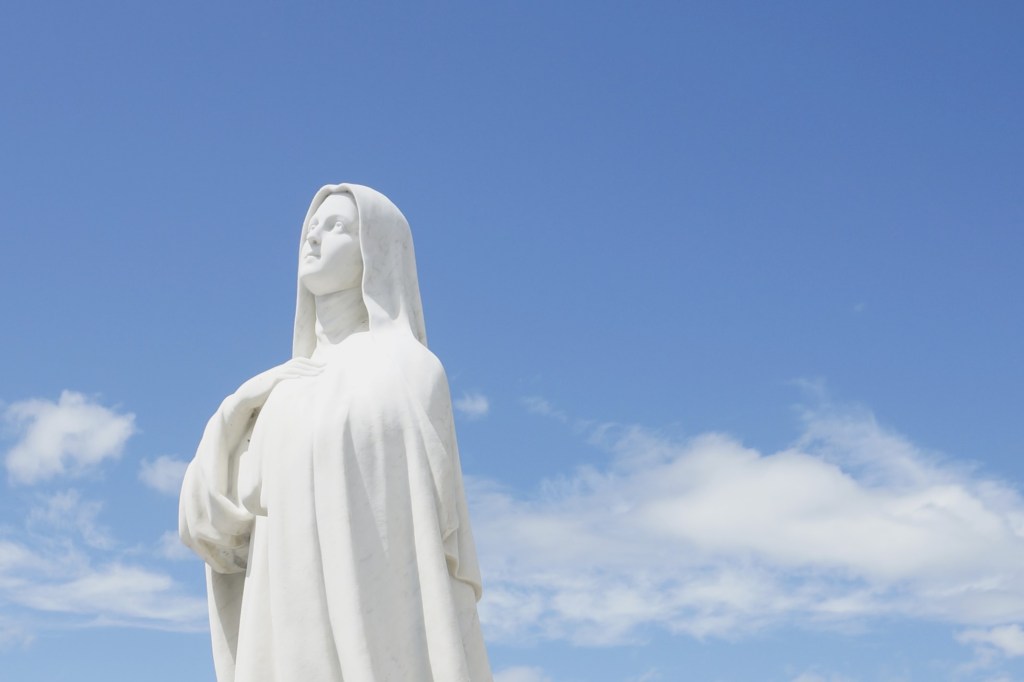
But Steffen Lösel (2008) sees in Thérèse’s relatively moderate mortification a sign of the education of girls in the nineteenth century. “When we compare Thérèse’s efforts to actively pursue suffering to those of many medieval women mystics, they appear rather insignificant. […] Thérèse denies herself the little pleasures of life that remain available within the walls of her convent, and she seeks out activities that others naturally avoid. Yet, she does not actively choose any rigorous forms of bodily self-castigation, which go beyond the (admittedly severe) rules of life in Carmel. In fact, Thérèse’s pursuit of suffering very much reflects the ideals of nineteenth-century education for girls – an education that, with the help of religion, attempts to cultivate in them a self-sacrificial and altruistic character, teaches discipline and constraint, and tries to subdue their will.”
Spiritual value of suffering
Suffering for humility
One of the most commonly known purposes of suffering is the quest for humility. The Spiritual Direction recommends to seek humility and self-hatred and to suffer from humiliation as a punishment for one’s sin. “[O]ne must always suggest to themself some good motive, such as acquiring the virtue of humility and self-hatred, suffering of some humiliation, in satisfaction for their sins or to honor some mystery of the Passion of Our Lord”.
Thérèse was aware of the value of suffering in order to stay humble. In a letter to her sister Pauline in 1888, she remarked “I find that ordeals help a lot to detach oneself from the earth, they make us look to things higher than this world” (LT 043).
In Story of a Soul (Ms.A 31 r°), she remembered the intense scruples she felt after revealing to her sisters that she saw a statue of the Virgin Mary smile at her. She reflected upon it, and understood the suffering she experienced might have been allowed by God in order to protect her from vanity: “No doubt, if I had kept my secret, I would also have kept my happiness, but the Blessed Virgin allowed this torment for the good of my soul, perhaps without it I would have had a thought of vanity”. She also commented on the value of suffering in achieving sainthood: “I understood that to become a saint one had to suffer a lot, always seek perfection and forget oneself”a (Ms.A 10 r°).
However, letter 247 to Maurice Bellière, a missionary to whom Thérèse was writing, reveals that suffering for humility and her own repentance was not her main goal.
“I know there are saints who spent their lives practicing astonishing mortifications to expiate their sins; but so what? ‘There are many dwelling places in the house of the Heavenly Father’, Jesus said so and that is why I am following the path he traces for me. I try not to bother about myself in any way anymore, and I leave to Jesus whatever he condescends to do in my soul, because I did not choose an austere life to expiate my faults, but those of others.
I have just read again my little note and I wonder if you will understand me, because I explained myself very badly. Do not believe that I blame the repentance of your faults and your desire to expiate them”.
As can be seen in the aforementioned extract, to Thérèse, suffering was above all a way to atone for other’s sins and to save their souls.
Suffering to save souls
Thérèse had a strong desire to save other’s soulsb. One of her most notorious successes was the conversion of murderer Henri Pranzini, for whom she prayed before his execution. Throughout her writings, she stressed that “by suffering we can save souls” (LT 043), and that Jesus “wants his little flower to save souls for him, he only wants one thing for that, that his flower looks at him while suffering his martyrdom…” (LT 127). “[O]nly suffering can give birth to souls for Jesus… Is it any wonder that we are so well served [in suffering], us, whose only desire is to save a soul that seems forever lost”, she added in LT 129. Indeed, to save souls, one has to suffer just as Jesus did to save sinners’ souls, and more specifically those who have the spiritual strength to suffer for those who do not, as she wrote in LT 085 “[l]et’s offer our sufferings to Jesus to save souls, poor souls!… they have fewer graces than us, and yet all the blood of a God has been shed to save them”. For Thérèse, most people could not save their own soul because to them suffering is “misunderstood, unknown, seen as useless by profane eyes” (LT 132).
Just as Jesus shed blood to save sinners, Thérèse suffered for souls. She replicated the holy suffering, a theme that we commonly find in her poems.
“For a long time I drank the chalice of tears
I shared your cup of pains
And I understood that suffering has charms
That by the Cross we save sinners.”
(PN 16)
“My joy is to constantly struggle
To give birth to elects.
It is the heart burning with tenderness
To often repeat to Jesus:
‘For you, my Divine little Brother
I am happy to suffer
My only joy on this earth
It is to be able to delight you.’”
(PN 45)
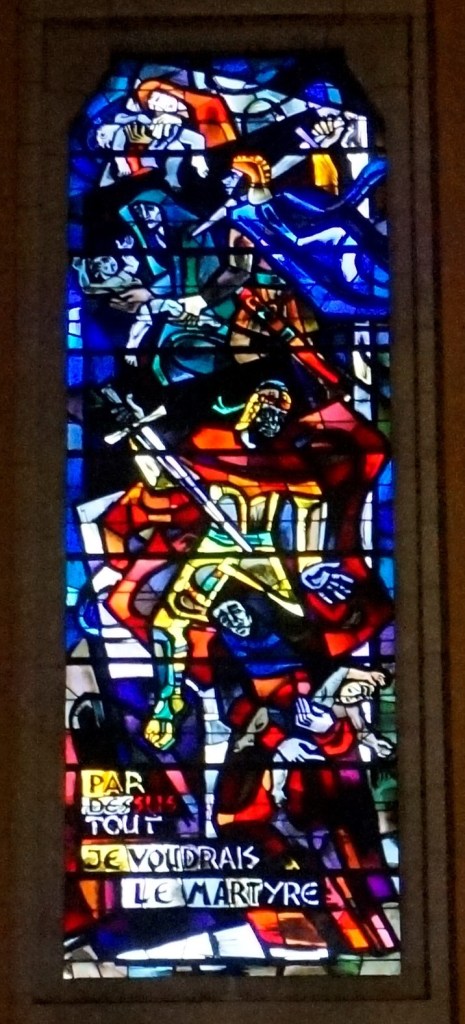
Both poems stress the value of suffering as a way to save souls, but also compare Thérèse’s suffering to that of Jesus. “In order to suffer in peace, you only have to want everything that Jesus wants… To be the bride of Jesus, you must resemble Jesus, Jesus who is all bloody, he is crowned with thorns!”, she wrote in a letter to her sister Céline (LT 087)c, following the teachings found in The Imitation of Jesus Christ, that Thérèse read and learnt by heart. Book III chapter XVIII states that “we must suffer steadily through the miseries of this life, following the example of Jesus Christ”. She reiterated this thought in poem 31, writing “I want to be like you, Lord. / The suffering, I demand it”. In that regard, Thérèse’s wish for suffering is reminiscent of the pain ascetics inflicted upon themselves to mimic – and get closer to – the Christ. The distinction however, is that Thérèse did not seem to directly seek suffering, but rather accepted suffering she believed had been sent to her by God. Accepting suffering can therefore be seen as an act of love.

Suffering as an act of love
God let his son Jesus suffer and die to save the souls of mankind, as explicitly stated in the Bible: “For God so loved the world that he gave his one and only Son” (John 3,16; NASB translation). Jesus accepted that suffering, not only for God, but for the sinners as well, whose souls he saved on the Cross. Therefore, suffering as an act of love is multidimensional and we can find these different aspects in Thérèse’s writing.
Indeed, Thérèse’s writing is rich in depictions of suffering as a form of love. Her love for Jesus made his suffering beautiful, as depicted in PN 20:
“My love discovers the appeal
Of your Face embellished with weeping
I smile through my tears
When I contemplate your pains…”
Suffering can also be an expression of love for God and Jesus. In letter 089 for example, she explained how suffering is an unavoidable part of devotion: “We shouldn’t believe we can love without suffering, without suffering a lot”. She later added in letter 094 “God is admirable, but he is especially lovable, so let’s love him… let’s love him enough to suffer as much as he wants”. “I want to suffer, I want to die for you…”, she reaffirmed in PN 31. Thérèse might here again have been inspired by the teaching in The Imitation of Jesus Christ, that stresses that “one does not live without pain in love. Who is not ready to go through all the suffering and to give himself entirely to the will of his beloved, does not know what it is to love” (Book III chapter V).
Later in her life, her love for God reached a new level of purity and selflessness as Thérèse began doubting the existence of Heaven. “Not only does the thought of heavenly happiness bring me no joy, but I even sometimes wonder how it will be possible for me to be happy without suffering. No doubt, Jesus will change my nature, otherwise I would miss the suffering and the vale of tears”, she explained in letter 258. This spiritual dryness followed her to her death. Despite such a crisis, Thérèse kept accepting suffering. She became completely disinterested in suffering for Jesus, as she expected nothing in return, neither recognition nor reward. It is therefore the deepest form of love for God (Vasse, 2008). Clapier (2005) commented: “In her attraction to suffering, it is fundamentally to Jesus that Thérèse adheres, and not to suffering” (excerpt translated by us). Russell (2000) corroborates this idea that Thérèse was not attracted to suffering itself, and refutes accusation of masochism, pointing out her disinterest from deliberately inflicted pain in cases of physical mortification. Suffering per se does not have any value, it is what is made of it that gives its meaning: disease stimulates medical research, death stimulates life, etc (Guelluy, 1991). As suffering alone was of no value to Thérèse, she did not object to the alleviation of pain, whether physical or mental (Russell, 2000) and she was frequently visited by a doctor to be treated with soft medicine of the time, such as ice, pancreatin, mustard poultices and cupping glaces (CJ July 1897), revealing that she did not refuse treatment. A few months before her death from tuberculosis, being aware of the ineffectiveness of the treatments she was undergoing, Thérèse asked God to keep these treatments for sick missionaries (CJ May 1897). She also prayed for her suffering relatives to receive some consolation for their sadness, and some healing for their health issues (LT 123; LT 146), showing that while Thérèse could appreciate suffering for spiritual reasons, she was empathetic to human sufferingd.
According to Thérèse, suffering can also be a way to initiate a soul to the love of God. It has an educational value that Thérèse was aware of (Clapier, 2005). “It is surprising to see how much my spirit developed during suffering”, she mentioned in Story of a Soul (Ms.A 27 r°) as she remembered her childhood sadness caused by the separation of her sister who entered Carmel. In the first pages of her manuscript, which she started writing two years before her death, looking back at her entire life, she concluded “my soul has matured inside the crucible of external and internal ordeals” (Ms.A 03 r°).
Thérèse did not simply suffer for God, but she saw suffering as God’s love for her, and the greater the love, the greater the suffering. She described herself as a “little victim of love” to whom Jesus sent suffering to her “out of love” (CJ September 1897). In letter 067, she explained: “I felt then that the best [Jesus] could give us was pain, that he only gave it to his favored friends”e.
Knowing that her suffering was inflicted by God enabled Thérèse not to be afraid, to go through “pain with no worry” (CJ August 1897)f. “Oh no, I will not fear his blows, for, even in the most bitter sufferings, you always feel it’s his gentle hand that hits”, she wrote in LT 043. She elaborated in August 1897, stressing the fact that God does not inflict a level of pain that one can not bear: “The good Lord gives me bravery in proportion to my sufferings. I feel that, for the moment, I could not endure more of them, but I am not scared, since if they increase, he will increase my courage at the same time”, Thérèse was therefore “happy to suffer since the good Lord wants it” (CJ August 1897).
Thérèse’s acceptance of suffering as a mutual form of love from and for God can be seen as a remarkable proof of her faith to some, or as a coping mechanism to others. Her “joy”, she wrote in PN 45, “is to love suffering”, she only desired “to always suffer for Jesus” (LT 043). Even on her deathbed, less than a week before her death, she reaffirmed that her “good is undoubtedly to suffer” (CJ September 1897). “I still want to suffer”, she said the day she died (Words Found). Despite Thérèse de Lisieux’s romanticization and desire for suffering however, it is important to keep in mind that she was not ignorant to the harsh reality of pain.
Thérèse knew what suffering was
A life of suffering
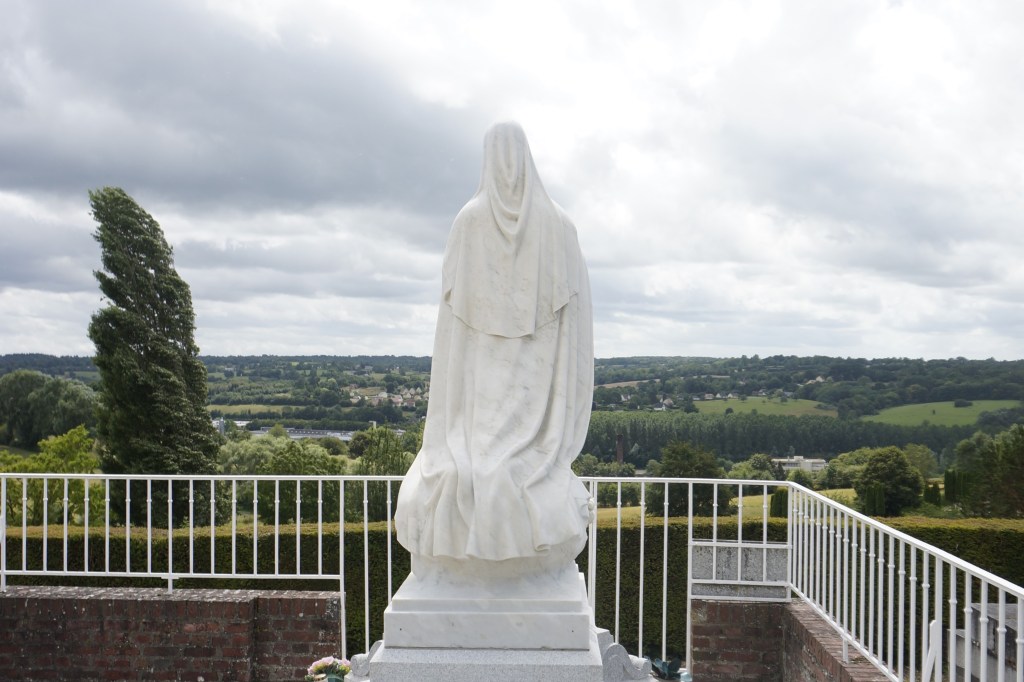
Indeed, her entire existence could be described as a life of suffering and she suffered from family separation and death since her early childhood. She spent the first year of her life with a childminder as she was ill. Her mother died when she was 4 years old, after which her previously cheerful personality became anxious. Later, when two of her sisters whom she saw as motherly figures, Pauline and Marie, departed to Carmel, she endured another painful separation (Lee, 2009). Thérèse, who was still a little girl at the time, saw Pauline as her confident and did not properly grasp the reasons for her departure for Carmel, which she had discovered by chance. She did not understand that Pauline’s apparent disinterest regarding Thérèse was only caused by the rigidity of Carmel. For Thérèse, this event brought forth what we would now consider depression (Vasse, 2008).
After this painful separation, Thérèse fell sick. She experienced doubts and guilt as she worried she could have pretended to have been ill. During this period, as she was bedridden, she believed she saw the statue of the Virgin Mary smile at her, miraculously aiding her sickness. She would subsequently tell her sisters about this event, which caused her to feel intense guilt and scruples as she felt that she had betrayed Mary by disclosing their secret.
The most painful experience Thérèse endured was the sickness of her father, who became mentally ill and was institutionalized in 1889, shortly after she entered Carmel at the young age of 15. Writing about this tragedy in letter 155, she realized “[t]his cross was the largest I could have imagined”, likening the emotional weight of this to that of the cross Jesus carried.
Thérèse’s life of suffering, and the agony she experienced from her fatal tuberculosis, has contributed to shaping the myth surrounding her. “Oh! I know what suffering is”, she exclaimed in the last month of her life, as reported in the Yellow Notebook. However, even though sainthood might place her close to God, it is important to keep in mind that Thérèse de Lisieux was human, and therefore experienced pain no differently than anyone else.
Beyond the romanticisation of suffering
Indeed, a closer look at Thérèse’s last months reveals that, on numerous occasions and more specifically during her agony, suffering was at points unbearable to her, and one of the reasons she had achieved such a high tolerance for suffering was because of the strength of her faith. “Had my soul not been already completely filled by abandonment to the will of the good Lord, had it been overwhelmed by the feelings of joy or sadness which come after one another so quickly on earth, it would be a bitter stream of pain and I couldn’t bear it”, she remarked in July 1897 (CJ July 1897). We find a similar comment in Story of a Soul (Ms.C 4 v°), which highlights that Thérèse’s love for suffering comes from the value she found in it throughout her life as she grew: “I have suffered a lot since I have been on earth, but while in my childhood I suffered with sadness, this is no longer how I suffer now, it is in joy and in peace, I am truly happy to suffer”g.
Nevertheless, in the end of July, the pain intensified and she started feeling what she called “great sufferings”, as opposed to the “small sufferings” she had previously endured in illness (CJ August). Thérèse, who had been so accustomed to suffering, started to experience an unknown intensity of pain until then:
“I did not expect to suffer like this; I suffer as a little child does… I would never want to ask God for greater sufferings. If he increases them, I would bear them with pleasure and joy since it would come from him. But I’m too small to have the strength on my own. If I asked for suffering, it would be my own suffering, I would have to bear it alone, and I’ve never been able to do anything on my own” (CJ August 1897).
On August 26, she expressed her inability to resist physical pain. “Ah! to suffer from the soul, yes, I can endure a lot… but regarding bodily suffering, I am like a little child: very small” (CJ August 1897).
In September, as Thérèse was entering the last month of her life, the disease became more advanced and the pain more severe. “Never would I have believed that it was possible to suffer so much! Never ! Never ! I can only explain it to myself by the ardent desires I’ve had to save souls”, Thérèse presumed (CJ september 1897). But as Lee (2009) pointed out, “in reality, her physical suffering cannot be over-romanticized. In the 19th century, medication for tuberculosis was not sophisticated and in monastic custom, Therese was not given any morphine or painkillers until at full death agony. She had to bear the unbearable suffering of fevers, blood coughing, short breath and intestine infection, etc”.
On September 5, her sister remarked that she seemed to have suffered less at some point, to which Thérèse explained she had suffered as much but simply did not complain to other carmelites but to the Virgin Mary instead. “Oh ! I suffered as much ! a lot, a lot! But it was to the Blessed Virgin that I complained” (CJ September 1897). This instance creates a sharp contrast with Thérèse’s acceptance of suffering, which we commonly find in her writing and last words.
On September 22, 8 days before her death, she revealed the disease and the pain were so intense that she would have killed herself had she not gotten faith.
“[W]hat a grace to have faith! If I didn’t have faith, I would have killed myself with no hesitation in no time at all” (CJ September 1897).
Reflecting on the suffering she has been enduring, Thérèse, during one of her last days of agony, remarked: “it’s very easy to write beautiful things about suffering, but writing is nothing, nothing! You have to be there to know! […] I feel now that what I said and wrote is entirely true… It’s true that I wanted to suffer a lot for the good Lord, and it is true that I still want to” (CJ September 1897)h. Even at the highest intensity of pain, an agony which she admitted that she had not anticipated, she did not give up faith.
Stressing Thérèse de Lisieux’s human nature, and therefore weakness, by no means diminishes her spiritual strength. On the contrary, it is her very ability to feel pain that gives her suffering its meaning and value. Thérèse herself seemed to contradict the romanticisation of pain. As a doctor visited her, shortly before her death, and, realizing she was enduring “a real martyrdom”, praised her “heroic patience”, she denied such claims.
“How can he say I’m patient! That’s lying! I keep moaning, I sigh, I cry all the time: ‘Oh! la la!’ and then: ‘My God, I can’t take it anymore! Have mercy, have mercy on me!’” (CJ September 1897).
Conclusion
Thérèse’s acceptance and love for suffering can be difficult to understand, especially for those who are not religious. For instance, after reading Story of a Soul, American author Sylvia Plath wrote that “[m]aybe only the nuns and monks come near [Jesus], but even they have this horrid self-satisfied greed for misfortune which in it’s own way is perverse as greed for happiness in this world: such as T’s “precious blessing of her father’s cerebral paralysis and madness: a welcome cross to bear!””. In Plath’s eyes, Thérèse’s father’s illness was no gift from God, it was merely a medical condition. Similarly to Thérèse, Sylvia Plath was not ignorant to suffering, which ultimately led to her suicide.
As suffering is a subjective and diverse experience, the values given to it are similarly diverse. Religion can help some accept unavoidable pain and embrace it, whilst others would use it as a motivation to fight it; but suffering is part of life and seeking to suppress all forms of suffering can only be possible by suppressing life. Similarly to Thérèse, it is through experience, opinions, and values that we shape our own relationship with suffering.
Notes
a – We also find this value of suffering as a way to reach sainthood in letter 089: “Holiness does not consist in saying beautiful things, it does not even consist in thinking of them, in feeling them!… it consists in suffering and in suffering in everyway.”
b – While Thérèse’s desire started growing before she entered Carmel, it grew in intensity after her taking of the habit. “Yes, suffering open its arms to me and I threw myself into it with love… In the examination which preceded my profession, I declared at the feet of Jesus in the Eucharist what I came in Carmel to do: “I have come to save souls and above all to pray for the priests.” When you want to reach a goal, you have to provide yourself with the means to do so; Jesus made me understand that it was through the cross that He wanted to give souls to me and my attraction for suffering grew as suffering increased.” (Ms.A 69 v°)
c- Thérèse applied this argument not only to herself but to her relatives. In letter 081 to Céline, she wrote: “You are privileged by his love, he wants to make you similar to him, why are you afraid of not being able to carry this cross without weakening?”
d – “there is nothing as painful as seeing those you love suffer” LT 059
“Oh! my darling Aunt, if I was the only one to suffer, I would not mind, but I know how much you take part in our ordeal, I would like to take away the entirety of your grief for your celebration, and carry all your sorrow myself. That’s what I was asking earlier to the one whose heart beat in unison with mine.” LT 067
“My dear Aunt, the good Lord must particularly love you to make you suffer that way, however if he listened to me you would never be sick again, because I would be happy if he agreed to send me all the pains that he keeps for you.” LT 084
“anything that makes you suffer hurts me deeply!” LT 114
“it is very sad to see those we love suffer like this” LT 129
“I want the good Lord to spare those I love as much as possible from the inevitable sufferings in life, at the risk of taking the ordeals he keeps for them myself if necessary.” LT 131
e – Other instances reveal Thérèse’s view of suffering as a treatment God reserves for his most cherished followers, in particular in the letters to Céline about the sickness of their father.
“God always puts those he loves to the test. I believe the good Lord causes suffering on earth so that Heaven seems better to his elects; he says on the last day he will wipe away all the tears from their eyes, and no doubt the more tears there are to wipe away the greater the consolation will be!…” LT 068
“Jesus must love you with a special love to test you in this way. […] God would turn the world to find suffering in order to give it to a soul on which his divine gaze has lingered on with an unspeakable love!…” LT 081
“Our dear father must be loved by Jesus to have to suffer like this” LT 082
“Each new suffering, each anguish of the heart is like a gentle breeze which will bring to Jesus the perfume of his lily, so he smiles with love and immediately he prepares a new bitterness, he fills the chalice to the top, thinking that the more his lys grows in love, the more it must grow in suffering as well!… What a privilege Jesus offers us by sending such great pain to us, ah! […] Now we have nothing more to hope for on earth, nothing more than suffering only and more suffering, and when we are done, suffering will still be there reaching out to us, oh! what an desirable fate…” LT 083
“Three years ago our souls had not yet been broken, happiness was still possible for us on earth, but Jesus let his loving eyes linger on us, eyes veiled with tears, and these eyes became for us an ocean of suffering, but also an ocean of grace and love.” LT 127
“But unfortunately ! the Good Lord knows the rewards he keeps for his friends and often he likes to make them earn his treasures through sacrifices.” LT 155
“My Brother, the beginning of your apostolate is marked with the seal of the cross, the Lord treats you as privileged; it is much more through persecution and suffering than through brilliant preaching that he wishes to consolidate his reign in souls.” LT 226
f – See CJ May 1897: “I am in no way afraid of the last fights, nor of the pain in illness, however great they may be, of illness. The good Lord has always rescued me; he helped me and guided me by the hand since my earliest childhood… I rely on him. I am sure that he will keep helping me until the end. No doubt even if I cannot take it anymore, I’ll never have too much.”
g- Thérèse discovered her love for suffering after a Holy Communion. She described that very moment in Story of a Soul (Ms.A 36 r°-v°): “The day after my Communion, Marie’s words came back to me; I felt a great desire for suffering emerge in my heart and at the same time the intimate conviction that Jesus was keeping a great number of crosses for me; I felt taken over with such great consolations that I see them as one of the greatest graces of my life. Suffering became my attraction, it had charms that delighted me without knowing them well. Until then I had suffered without liking suffering, since that day I felt a true love for it.”
See also CJ July: “Since my First Communion, since I had asked Jesus to replace for me all the consolations on the earth with bitterness, I had an endless desire to suffer. I didn’t think, however, of making it my joy; it is a grace that was only granted me later.”
h – Thérèse expressed a similar parallel between words about suffering and the bearing of such suffering about the illness of her father: “I remember that in June 1888, at the time of our first ordeals, I said: ‘I am suffering a lot, but I can feel that I can still bear greater ordeals.’ I did not think then of those which were saved for me… I did not think that on February 12, a month after my taking of the habit, our dear Father would drink the most bitter, the most humiliating of all goblets… Ah! That day I did not say that I could suffer even more!!!” (Ms. A 73 r°).
References
Quotes taken from the Archives of the Carmel of Lisieux were translated by myself, based on the original French text to compensate for the poor quality of the English translation provided by them. For the sake of clarity however, and to make potential readers’ research easier, this list links to the original English translations of each text.
Aguado, J. F. (1992, August-September). The value of suffering. Position Paper, 224-225, 261-264.
Castel, M.-L. (n.d.). Correspondence with Sister Germaine. Archives du Carmel de Lisieux. https://archives.carmeldelisieux.fr/en/au-carmel-du-temps-de-therese/la-communaute/soeur-marie-de-la-trinite/documents-soeur-marie-de-la-trinite/correspondance-avec-soeur-germaine-1908%E2%80%911917-carmelite-dangers/
Castel, M.-L. (n.d.). Le carnet rouge de soeur Marie de la Trinité. Archives du Carmel de Lisieux. https://archives.carmeldelisieux.fr/en/au-carmel-du-temps-de-therese/la-communaute/soeur-marie-de-la-trinite/documents-soeur-marie-de-la-trinite/le-carnet-rouge-de-soeur-marie-de-la-trinite/
Clapier, J. (2005, may-june). Thérèse de Lisieux et la souffrance humaine. Communio, XXX(3), 111-123.
Descouvemont, P. (2022). Thérèse et la souffrance. In Lettres de Thérèse de Lisieux (pp. 375-378). Éditions Emmanuel.
Guelluy, R. (1991). La souffrance. Approches spirituelles. Revue théologique de Louvain, 22(2), 185-201. https://www.persee.fr/doc/thlou_0080-2654_1991_num_22_2_2499
The Imitation of Jesus Christ (F. de Lamennais, Trans.; Vol. III). (1873). Tours: Alfred Mame and Son, publishers. https://archives.carmeldelisieux.fr/en/au-carmel-du-temps-de-therese/le-style-de-vie/la-lecture-spirituelle/la-bibliotheque-communautaire/livres-de-la-bibliotheque/limitation-de-jesus-christ/limitation-de-jesus-christ-livre-iii
Lee, S. M. M. (2009). Theological Meaning and Practice of Suffering in the Spirituality of Saint Therese of Lisieux (1873-1897).
Lösel, S. (2008, July). Prayer, Pain, and Priestly Privilege: Claude Langlois’s New Perspective on Thérèse of Lisieux. The Journal of Religion, 88(3), 273-306. https://doi.org/10.1086/587145
Martin, C. (n.d.). Conseils et souvenirs d’une novice. Archives du Carmel de Lisieux. https://archives.carmeldelisieux.fr/au-carmel-du-temps-de-therese/la-communaute/soeur-genevieve-de-la-sainte-face/conseils-et-souvenirs-dune-novice/
Martin, T. (n.d.). Correspondence of Thérèse. Archives du Carmel de Lisieux. https://archives.carmeldelisieux.fr/en/oeuvres-de-therese/correspondance-de-therese
Martin, T. (n.d.). Poems. Archives du Carmel de Lisieux. https://archives.carmeldelisieux.fr/en/oeuvres-de-therese/poesies/
Martin, T. (n.d.). Story of a Soul. Archives du Carmel de Lisieux. https://archives.carmeldelisieux.fr/en/oeuvres-de-therese/manuscrits/
Plath, S. (2000). The unabridged journals of Sylvia Plath, 1950-1962 (K. V. Kukil, Ed.). Knopf Doubleday Publishing Group.
Renault, E. (1889). Modesty and Mortification of the Senses. In The Paper of Exaction. https://archives.carmeldelisieux.fr/en/au-carmel-du-temps-de-therese/le-style-de-vie/regle-et-autres-textes-de-base/le-papier-dexaction/#de-la-modestie-et-de-la-mortification-des-sens
Russell, K. C. (2000). St. Thérèse of Lisieux on Suffering. Spiritual Life, 46(4), 230-239.
Spiritual Direction. (1869). https://archives.carmeldelisieux.fr/en/au-carmel-du-temps-de-therese/le-style-de-vie/regle-et-autres-textes-de-base/direction-spirituelle/
The trial of non-cult. (n.d.). Archives du Carmel de Lisieux. https://archives.carmeldelisieux.fr/en/naissance-dune-sainte/les-proces-la-sainte-de-therese/le-proces-de-non-culte/
Vasse, D. (2008). La souffrance sans jouissance ou Le martyre de l’amour: Thérèse de l’Enfant-Jésus et de la Sainte-Face. Éd. du Seuil.Yellow Notebook. (n.d.). Archives du Carmel de Lisieux. https://archives.carmeldelisieux.fr/en/oeuvres-de-therese/dernieres-paroles-de-therese/carnet-jaune-bis/
 Exploring self-harm