
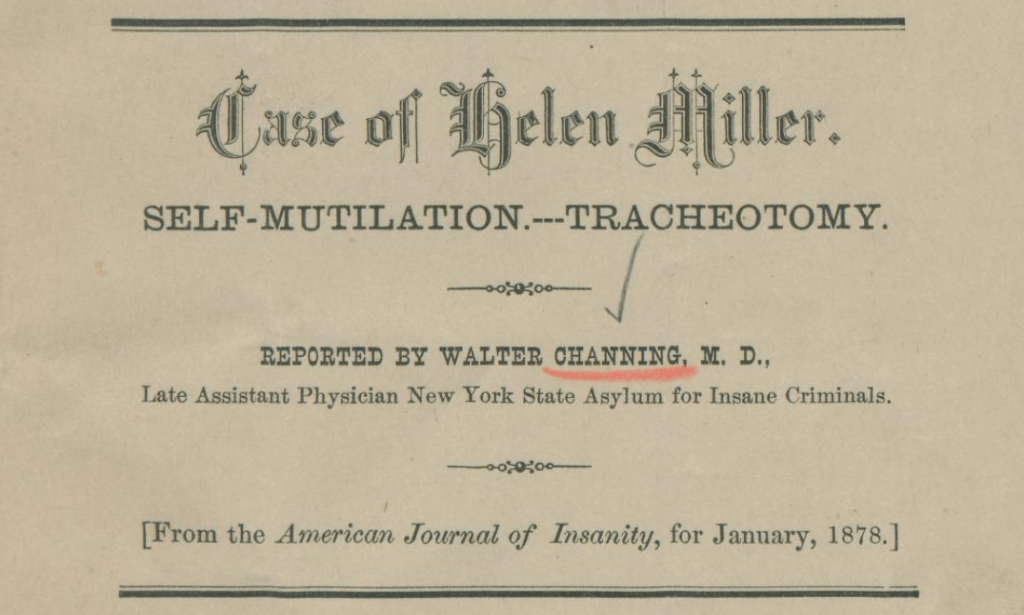
“CASE OF HELEN MILLER. – SELF-MUTILATION. – TRACHEOTOMY.” is a report written by Walter Channing and posthumously published in the American Journal of Insanity in 1878.
Walter Channing (1786-1876) was an American obstetrician and physician. In 1832 he contributed to the foundation of the Boston Lying-in Hospital to give destitute women safe maternity care to give birth. He advocated for anesthesia during childbirth despite harsh criticism from his peers who deemed it unsafe and from clergymen who saw it as against God’s punishment to Eve and all women, forcing them to give birth in pain. Furthermore, he participated in programs to relieve poverty after witnessing disease and death in Boston’s slums (Kass, 2004).
Before the 1870s, most cases of self-mutilation described in literature were often extreme forms associated with madness such as emasculation. The 1870s saw the appearance of two new possible motives for self-harm: malingering and manipulation. Female self-harm was often seen as a symptom of hysteria and described as attention-seeking and a way to get sympathy, while male self-harm was commonly seen as a way to escape work or get financial benefits. This article perfectly fits this framework (Chaney, 2017a; 2017b).
Summary of the article
The article reports the case of Helen Miller, a German Jewish woman who suffered from various conditions including dysmenorrhoea (painful periods), kleptomania, and opium use. The article primarily focused on her acts of self-mutilation, with precise description of her injuries.
Hellen Miller was first admitted to the New York State Asylum for Insane Criminals in October 1872, when she was 30; where Channing worked as an assistant Physician.
No official medical record was made of this, although the article reports she spent most of her time in bed. She was discharged in December 1874.
Shortly after her discharge she was arrested again for grand larceny and sentenced to 5 years in prison. Thereafter she began cutting and was readmitted to the asylum in July 1875. For several days she suffered from hematemesis (blood vomiting) that no remedies could cure. Yet, despite the blood loss, she remained in perfectly good condition which led to a suspicion that she was faking her symptoms. Treatment was suspended and she stopped vomiting blood. The technique she used to simulate hematemesis was also revealed. She then suffered from dysmenorrhoea and dysentery – an infection of the intestines – and was bedridden for most of September 1875 during which time she became depressed due to her long prison sentence.
On September 25th, she broke a pane of glass and cut her left wrist, in an attempt to sever her arteries. She seemed to feel almost no pain while her injury was stitched but she was agitated and shaking. Despite Hellen Miller regretting her act, she cut herself deeply again, 3 weeks after the first incident and inserted glass and wood splinters in her cut. The injuries took 6 weeks to heal, after which she became depressed again and cut both her arms. One arm did not heal properly and she suffered from serious complications. As her general health kept deteriorating, ultimately leading to potential suffocation, tracheotomy was performed.
Despite her chance of recovery being very low, she regained health but remained weak for almost 2 months, during which she was patient and cheerful. During the last 2 weeks of her convalescence, she became depressed again and cut her arms. Over a period between December 1875 to April 1876 she injured herself approximately every six weeks. In April she requested to be transferred to prison but was informed she would be transferred only on the condition that she does not self-mutilate for 6 months. Shortly before the end of the delay however, she injured herself again and repeated her act 6 months later. She cut for the last time in June 1877.
In total during all these incidents, she had inserted 150 objects in her injuries. Despite not being allowed to use any object made of glass, she had still been able to procure glass either by hiding it or being given some by other patients. Channing writes that “strange as it seems she apparently experienced actual erotic pleasure from the probings she was subjected to” and comments that she did not feel pain when injuring herself. According to Channing, her self-mutilation was at the same time a suicide attempt (and sometimes a simulation of such attempt), a means to make others suffer as she believed she was persecuted by other patients and a way to get attention. Indeed, he describes her as hysterical and explains she felt the happiest when her wounds were healing as she had the attention of physicians. Her wounds were apparently performed in a way and conditions that would maximize their effect on others.
References
Chaney, S. (2017a, March 6). The Victorians are to blame for assumptions that self-harm is just attention-seeking. Retrieved from The Conversation: https://theconversation.com/the-victorians-are-to-blame-for-assumptions-that-self-harm-is-just-attention-seeking-72680
Chaney, S. (2017b, August 15). Why Should We Care What the Victorians Thought of Self-Harm? Retrieved from Psychology Today: https://www.psychologytoday.com/us/blog/the-history-self-harm/201708/why-should-we-care-what-the-victorians-thought-self-harm
Channing, W. (1878). Case of Helen Miller.—Self-mutilation.—Tracheotomy. American Journal of Psychiatry, 34(3), 366-378.
Kass, A. (2004). Vita: Walter Channing. Harvard Magazine, 106(4), 44-45.
 Exploring self-harm